Showing posts with label music. Show all posts

Monday, May 24, 2010

Carl Orff's Carmina Burana

On Saturday, we went to a production of Carl Orff's Carmina Burana.  We got to enjoy the beautiful singing by the Texas Master Chorale which includes TWO of our homeschooling friends. One of our friends is my piano teacher and she is the one who invited me. I was surprised to see another friend performing. She was born in South Africa and moved here about 2 years ago from Canada with her husband and 3 daughters who are triplets. She used to sing opera and attends my church where she sometimes sings solos.


Anyway, besides the 100 member chorale, there were also a live orchestra (the percussion parts are amazing!) and children's choir. The whole event was phenomenal. The songs are poems that were written in the 11th and 12 centuries in Latin and German. They were found in 1803 and, in 1935 & 1936, Carl Orff put 24 of the poems to music. The entire performance lasts about 71 minutes. A lot of the movements are very lively and the most famous piece is called O Fortuna. I found recordings of the entire performance of Carmina Burana online, but I have included a great recording of O Fortuana here. If you get a chance to see Carmina Burana, I highly recommend it!

Tuesday, May 04, 2010

Virtual Choir

Alex was pretty sick yesterday, though she is much better today. We didn't do any "school" yesterday, and have been taking it pretty light today. We've read some from her history book and are watching a few educational movies I've recorded on our DVR.


We started our day by watching CNN Students News for yesterday and today. One of the news pieces was about a Virtual Choir which is conducted by Eric Whitacre. Basically, people from around the world (12 different countries) bought the same recording of this song and made a video recording of themselves singing their part while Eric directed them through the recording. Then, they sent in their audition pieces. The condutor put it all together and this beautiful "virutal chior" was created. I think it is amazing!


This 2nd video is by one of the singers, 18-year-old Melody. She has recorded her own voice in the various parts and it is beautiful! (She also has other songs.)

Tuesday, October 27, 2009

To the Opera

Houston Grand Opera offers a student-adapted opera for children in 4th-8th grades. We're excited to be going this year for the first time. (If you live in Houston, there might still be tickets available. Tickets are just $10 each.) I was really excited when I got a call last week from a volunteer docent who said she'd be coming out to tell our students about opera in general, this particular opera The Elixir of Love, and show clips from this opera!. I was thrilled that they were willing to do this for just 10 homeschoolers! And, we only had 6 here for the presentation. The lady was wonderful and I'm excited about going to see this opera.

Alex has been to see 5 or 6 operas for children with Houston Grand Opera to Go. In fact, we went to see Hansel and Gretel just a few weeks ago. Three years ago, we also went to our first full-length opera,  which was also Hansel and Gretel. It was incredible! (Next week's production will be shortened to 2 hours.)
I've been enjoying yet another of Jimmie's Squidoo pages, Opera for Children. I've requested a few books at the library. And, her page reminded me to look for clips of the opera online, like the one above which is a short summary with brief clips of this opera. The opera is sung in Italian, but there will be English subtitles. Also, we know the basic story now, so it'll be easy to follow. It is a comedy and has lots of lively music, so I hope all of the kids (and moms) have a wonderful time.

Tuesday, June 09, 2009

Baroque Music


This week's free unit at CurrClick is an ebook called The Baroque Era: Art, Architecture and Music by Intellege Unit Studies. I downloaded it and I'm really impressed! We are on summer break, but I plan on seeing if Alexandra would like to do this study just for fun! (I also think their Great Lakes study looks WONDERFUL!)
As I've mentioned before, I'm taking piano lessons this year as an early advanced student playing classical music. I am currently learning my second Bach piece, Invention #14. This piece (and my other piece) includes a fugue. (And, it is amaing to me that Bach wrote these pieces for his children to SIGHT READ! They are HARD!!!)
Bach was famous for his fugues which are basically like rounds where different parts start a melody and then another part copies it. (Kind of like Row, Row, Row Your Boat) I'm doing 2 part fugues which are really pretty difficult but Bach also did 3 part and 4 part fugues. (Maybe even 5 part? I'll have to find out.)
I found this site by Capistrano School that explains fugues very well. They also cover the 3 composers covered in the free unit study: Vivaldi, Bach, and Handel. (The other piece I'm currently working on is by Handel! I love Baroque music and get to play on my piano teacher's keyboard using the harpsicord sound - it's amazing! Her other keyboard is a grand piano which I love as well.)
Besides the composers, the study also covers art and architecture. I would really love to dive into this study this summer as it doesn't fit very well with our "ancient" focus for next year!

Sunday, May 25, 2008

From the Top at Carnegie Hall

A few months ago, we happened to catch "From the Top at Carnegie Hall" on the radio. And, we learned that it's also a TV show. This show is about kids, ages 8 to 18, who excel at music. They are amazing!!!

Season 2 started earlier this month and I now have my DVR set to record them. I should have my first episode to watch today! But, even if you can't record them, you can watch them online HERE. They have videos of all of season 1 and the start of season 2 there. And, they also have a "for teacher's" page with activities and additional links to videos, etc. So, enjoy some music!!! Maybe your child, or you, will be inspired to create some music of their own... or at least to practice the piano a little more. :-)

Wednesday, May 21, 2008

The Four Seasons... and Memorial Day


(Above video: "Winter" from "The Four Seasons" - I know I'm more familiar with "Spring", but this piece is lovely! And, I love the pan flute! What a seldom-seen instrument.)

I love what Melissa at In the Sparrow's Nest is doing for spring and the four seasons. She is using the book Nature's Paintbox which depicts each of the four seasons in a different medium. She is using those mediums to make their own pieces of art. They did a GREAT job with spring!

Along with that, she mentioned Vivaldi's "The Four Seasons." I commented on her blog that we might start studying Vivaldi & The Four Seasons. We have a piano book I picked up a month or so ago called
Antonio Vivaldi: The Four Seasons in an easy arrangement for piano. But, it isn't "that" easy. :-) My daughter's been playing since August and she couldn't play it. But, I've played for about many years, and I'll do just fine. It has pictures and poems and the piano music.

After listening to a sample at Amazon, we requested Classical Kids
"Vivaldi's Ring of Mystery" from the library. We also requested "I, Vivaldi" by Shefelman. And, we plan on using The Four Seasons at Classics for Kids, which Melissa also recommended.

I also have
Beethoven's Wig 2 which has the "Spring" piece from The Four Seasons. I hear it and in my head I hear, "It's spring, let us sing, Vivaldi!" OK, we really need to get that CD out tomorrow. (Oh, and I just saw that they have Beethoven's Wig 3!!!)

We might wait and do this study in the summer, but I wanted to post it here so I have everything in one spot.
And, on a different "note", I just bought a Memorial Day set of 12 minibooks to make a lapbook from Lilliput Station. This is actually a project her daughter helped her create. (See May 21st post) So, we'll probably be working on that during the next few days.

Monday, February 18, 2008

Wolfgang Amadeus Mozart

Alexandra and I recently studied our first composer, Mozart. We read lots of books about Mozart, listened to CDs, and listened to Classics for Kids online. And, we read about and listened to excerpts of The Magic Flute.

Our "core" book was Mozart, The Wonder Boy. Besides the story book, which is a great living book, you can also buy the companion CD (which also includes Bach) which includes audio files of all the music included in the book, coloring pages for each chapter, and printable sheet music for all of the music. We also used the study guide which includes chapter questions and LOTS of "tidbits of interest." Since I play the piano, I also enjoyed playing the pieces that were in the book, especially hearing the Minuet in G that Mozart wrote when he was only 5 years old!!!

In The Wonder Boy, the author relates a story of when little Wolfgang meets Marie Antoinette. It says, "The floors are highly polished and very slippery. Suddenly Wolfgang trips and falls. Little Marie Antoinette bends down quickly and helps him up. He smiles at her. "Thank you. You are kind. Some day I will marry you."" Following this, we really enjoyed reading about Marie Antoinette, too.
Here is a list of the resources we enjoyed:
  • Mozart, The Wonder Boy (with CD and study guide) by Opal Wheeler and Sybil Deucher, originally printed in 1934
  • Mozart: Scenes from the Childhood of the Great Composer by Brighton
  • Young Mozart by Isadora
  • Mozart Tonight by Downing
  • The Magic Flute retold by Greaves
  • Pet of the Met by Lydia & Don Freeman - WONDERFUL book we read many times - it is actually about a mouse family who lives at the Metropolitan Opera House and loves The Magic Flute!
  • Moi & Marie Antoinette by Lynn Cullen - VERY good book we read several times - I would buy this one
  • Mozart: Getting to Know the World's Great Composers by Venezia
I also posted more of our studies here where I talked more about The Magic Flute, here where I talked about the Queen of the Night's aria (and posted a youtube version), and here where I talked about the delightful Papageno (and posted a youtube version).

Monday, February 04, 2008

Sing Me a Story

I think I've mentioned several times that we were studying Mozart in January because we were supposed to see a kid's version of The Magic Flute, but we missed it because of our viruses. We really enjoyed the story of The Magic Flute and particularly enjoyed a book called Sing Me a Story: the Metropolitan Opera's Book of Opera Stories for Children. We read 2 chapters of this in bed while I was sick. We read both the story of The Magic Flute and Hansel and Gretel, which we saw performed last year.

The stories in the book are fairly short and have some illustrations. But, what we really enjoyed, was acting out these operas. We got various teddy bears, dolls, etc and assigned them roles to act out. Alexandra also made props out of pony tail bands and tissue. It was a lot of fun and made the stories more "real" and memorable.

There's also a book by the same author called Dance Me a Story: Twelve Tales from the Classic Ballets. I'm adding both of these books to my wish list!

Wednesday, January 16, 2008

Queen of the Night

I had to share another youtube video from The Magic Flute. Alexandra and I both LOVE this song from The Magic Flute. We actually first heard this song, The Queen of the Night's Aria, and Papageno's Song on The World's Very Best Opera for Kids... in English. (Could someone please leave a comment explaining how I can get photos of books and CDs from Amazon on my blog? Someone talked me through it once a long time ago, but I didn't try it and I've forgotten. Thanks!)

I'm not sure how kid-friendly this clip is - there is a dagger in the scene and the Queen of the Night is quite angry and her daughter, Princess Pamina, is very upset. Like the video of Papageno's Song, (previous post) you might want to fast-foward this one. The singing starts at about 2:10 and our favorite part starts at about 2:48. It's incredible!!!

In this scene, (it's in German so you probably won't understand it), the Queen of the Night is angry at Sarastro, the King of the Light. The Queen of the Night gives Princess Pamina, her daughter, a dagger so she can kill Sarastro. We love the Queen's voice and sometimes I sing that song, especially the part where the notes are so high. (by Alexandra)


Plans

I've got so many plans going right now, I'm not sure what I'm doing! :-)

We are continuing are study of the Pilgrims and the Colonists. We've been reading a few books and doing the Colonial American History Pockets which we will hopefully complete after a few more days. Then, I'm not sure if we'll move on or cover The Great Colonial America Projects book.

We've also been studying Thomas Edison and electricity. This hasn't been part of our school day - we started by watching a movie and then we've read several books at night. I'd like to get into this, as I mentioned, and actually study electricity and use Alexandra's new Snap Circuit kit.

We also did some dentistry experiments this week using martinzoo's ideas. Alexandra loved Dr. Rabbit and the Legend of the Tooth Kingdom and has watched it several times. We also enjoyed the experiments at martinzoo.

We're also studying Mozart in preparation for going to see a kid's version of The Magic Flute next week. This has been a really neat study, but we haven't really done any projects so I don't have any photos to share. I'll share all of my ideas and resources after the opera!

Lastly, today I met with my friend that I did a co-op with last year. She was on the road most of the fall, so we haven't really had time to get together. Well, we've decided to start up our co-op again! We're going to be studying for exhibits coming to our local museums. Our first study is genetics for the upcoming "Genome: The Secret of How Life Works." Does anyone have any ideas (or links) for hands-on genetics studies for younger children? Or a book recommendation? I've requested Gregor Mendel: the Friar Who Grew Peas from the library, but that's it.

We're just running all over the place, aren't we? But, we're having lots of fun!

I'll leave you with a video of one of our favorite songs from The Magic Flute. It is called Papageno and it is very lively and fun. You might want to fastforward to about 5:30 to get to the "best part", though it's all good. (The first part of this clip might not be suitable for all children. You might want to check it out first, though Alexandra really enjoyed it.)

In this scene, Papageno, the bird-catcher, is very sad because he can't find a wife. He has decided to kill himself. Three gentle spirits stopped him and told him to ring the magical bells. Papagena comes and they sing "pa...pa...pa..." back and forth and hop like chickens. And, at the end, we thought it was funny that Papageno carried Papagena away. When it was over, I thought Papagena should have sat on Papageno's hand like a bird. (by Alexandra)

Saturday, January 12, 2008

The 5 Browns

We did have a great end to our day last night. We went and watched a concert performed by The 5 Browns! They are 5 siblings, ages 22 to 26, who all went to Juilliard and play classical piano together. They were actually all born in Houston and their first piano teacher, who started teaching them each at age 3, and their parents were in attendance at the concert. It was a wonderful concert!

Monday, October 15, 2007

Math Fun for Fall and Halloween

We've been playing some great fall & Halloween math games the past few days. I'm sorry I forgot whose blog I read about it on, but these games come from Mathwire.

A fun game to work on coordinates

On this activity (and there is also a monster), they tell you how to color each grid square, and when you're done you have a picture. Cute!

And, with these 2 guys, we were working on symmetry. This would also be great to make a Jack-o-Lantern or a leaf person.

They have TONS more fun games and activities and we've enjoyed every one of them that we've tried. So, take a look and have some fun with math this month!
P.S. Marjorie had left a comment on my opera post asking about ideas for Hansel and Gretel. At Mathwire, they also have a graphing project for a gingerbread house that looks like fun!

Saturday, October 06, 2007

The Barber of Seville & Oak Gall Ink

Yesterday, we spent the day with 2 other homeschool families. First, we attended an outdoor opera, especially for kids and in English, of The Barber of Seville. One of the main characters is Figaro, and you're probably familiar with the opera song that repeats his name. The story was great and had a lot of humor and the opera performers were wonderful. We all enjoyed it.
This photo is of the characters warming up. The singer for Figaro actually had a sore throat and wasn't able to perform all of his songs on his own. So, his understudy sang near the piano (it had live music and the pianist was wonderful) while the actor acted and mouthed the words. It worked out very well and it's a great time to talk about what an understudy is.

This was our 4th children's opera, I believe, but I think it was the first for the other 8 in our group. We enjoyed how the singers/actors stayed out on stage afterwards and talked about what part they sang in the opera (ex. baritone, the lowest of the men's voices) and answered questions.


Afterwards, we had a picnic which turned into a small nature study. We found some growths on an oak tree and didn't know what they were called until the 13-year-old girl told us they were oak galls. And, she told us they used them to make ink! I was shocked that she knew this, and intrigued! So, I did some research. (Above: kind of blury photo of oak gall.)

So, here's some of what I learned:


What is an oak gall?
"Galls are irregular plant growths which are stimulated by the reaction between plant hormones and powerful growth regulating chemicals produced by some insects or mites. Galls may occur on leaves, bark, flowers, buds, acorns, or roots. Leaf and twig galls are most noticeable."
Also called iron gall ink, just what is it?

Definition: "Iron Gall Ink is a highly acidic ink produced from oak gall nuts. It fades to brown in the light, and its corrosive effects cannot be halted. The acids in iron gall ink react with the collagen in the surface of parchment, making it highly permanent, unlike carbon inks which easily rub off the impervious surface. However, the acids can also destroy documents, creating a challenge for historians, who have to read the holes burnt in ancient papers, and conservators, who need to find a way to neutralize the acid. For this reason, it is advisable to choose a modern archival ink in preference to making this traditional ink." (Above photo and definition taken from this site shows how the ink can burn holes in ancient papers.)

Who used it and what has happened?
"Iron-gall ink was the most important ink in Western history. Leonardo da Vinci wrote his notes using iron-gall ink. Bach composed with it. Rembrandt and Van Gogh drew with it. The Constitution of the United States was drafted with it. And, when the black ink on the Dead Sea Scrolls was analyzed using a cyclotron at the Davis campus of the University of California, it was found to be iron-gall ink."


Why is it brown?
"IRON GALL INK is naturally a purplish-black, but with time and exposure to light, it changes to a brown color. Its essential ingredients include plant tannins extracted from gall nuts, to which are added iron salts and gum arabic. This ink has a natural acidity whose corrosive effect on paper can often be seen in old master drawings." (from this site)

So, when they used this ink, it became this highly recognizable brown color as shown in the ink sketch by Rembrandt above. Can't you just picture da Vinci's drawings and notes from his notebooks?
Well, I just found this whole topic intriguing. And, I asked the girl and her mom where she learned this from and they didn't know. The mom said she just knows lots of "stuff" because she's always reading! Another reason to read!

Wednesday, December 06, 2006

Hansel and Gretel

WOW!!! We went and saw the opera of Hansel and Gretel today. We have been to quite a few children's operas, but this was our first full-length opera. I wasn't sure what it would be like, but it was amazing!

This was a new production in that it added puppets! And, they were incredible. Some highlights:
  • cat puppet that used 3 puppeters to operate it
  • Hansel and Gretel's parents walked on stilts (so they were about 8 foot tall)
  • the "14 angels" were flying puppets
  • the Sandman was adorable and used 2-3 puppeters
  • the witch was 12 foot tall! Incredible! And, she used an additional 4 puppeters (besides the opera singer)! It was just amazing!!!
The whole thing was just larger than life. A friend emailed that she had some additional tickets for tomorrow night, and we would have went again if we didn't have a previous commitment. What a great show!!!

Saturday, November 11, 2006

Sound, the Ear, and the Armonica


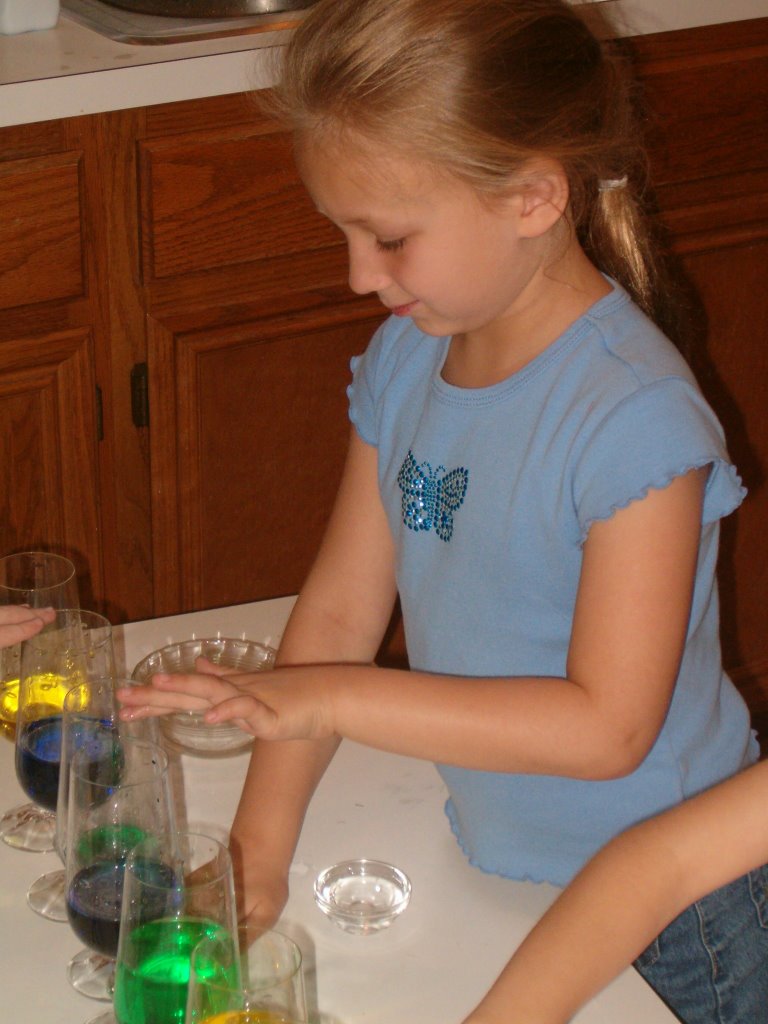
With the Ben Franklin exhibit in town, we got together with some friends this week to talk about his invention of the armonica. My friend was in charge of teaching, and she did a neat job of talking about sound, the ear, and the armonica.
First she talked about sound waves and demonstrated them. Then, she discussed a model of an ear and showed a book with photos of the parts of an ear. After that, the children got to go through a kid-size model of the ear - complete with ear canal, ear drum, "small" bones, and the auditory nerve. They loved this!!! The 3 girls asked to do it over and over again.
After this, we went on to listen to music played on crystal glasses brought to us by the internet. Then, she got out her crystal glasses and the girls learned to play them! It was a lot of fun, and I know the girls learned a lot. Thank you, Ms. S!!!
(My camera no longer takes good pictures indoors, so I really didn't get but a few, poor photos!)
Good book: The Magic School Bus Explores the Senses - great diagrams, fun story, and informational "reports"

Monday, June 19, 2006

Don Quixote

On Saturday, after our rained-out swim meet, we went to see the ballet of Don Quixote. We had read several books about Don Quixote, but they weren't very much like the ballet. The ballet was mainly a love story between 2 other characters, and "the Don" just came in and out of the story. It was a wonderful, funny ballet. It lasted over 2 and a half hour with 2 intermissions!

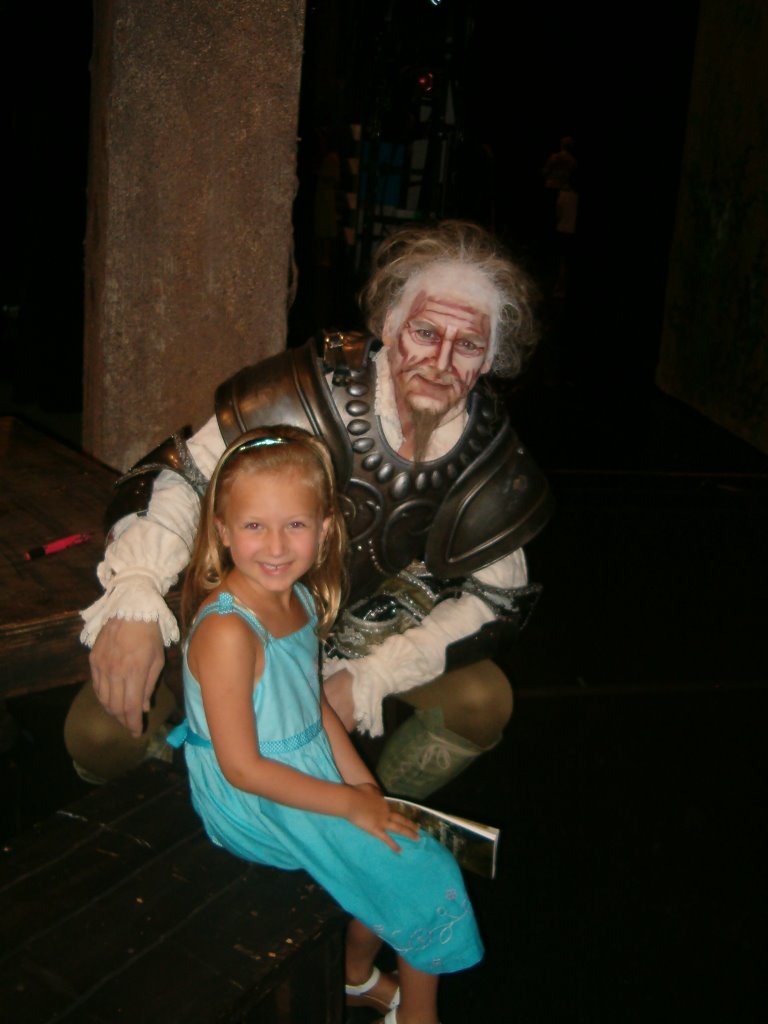
Afterwards, Alexandra got to go backstage to look at the props (incredible!) and get autographs and photos. This picture if of Alexandra and Don Quixote.

Last year we had family season tickets to the symphony and this year to the ballet. We're thinking about getting tickets to the opera next year....
Related Posts with Thumbnails