- They must read two books of poetry (Alex chose a book of poems by Henry Wadsworth Longfellow and a Shel Silverstein book)
- They had to choose a poet to study (actually, they submitted 2 choices and the poet was assigned - Alex got her 2nd choice, Longfellow - her first choice was Emily Dickinson)
- The teacher is reading aloud the book Hidden by Helen Frost
Thursday, April 12, 2012
Poetry Month: A Different Kind of Book
Friday, February 10, 2012
Out of the Dust
He said he was probably about 12 years old and he remembers they had a hard time making a living because there was no rain. It was "terrible, terrible, terrible, terrible, terrible." He said people were "going to California in droves", but no one he knew personally. They were "going to try to get work. They'd lost everything they had. Maybe they had a few dollars, so they headed to California and maybe on the way they had to find work." They'd stop for a little while and earn a little more money to continue on their way to California. "The dust was really bad," he repeated several times.
American Exeperience has a movie called Surviving the Dust Bowl that is available online for free. It's an hour-long movie, but this clip is only about 8 minutes. They also have a Teacher's Guide, interviews, and much more!
I always recommend the books by Mike Venezia, and he has one about Dorothea Lange!
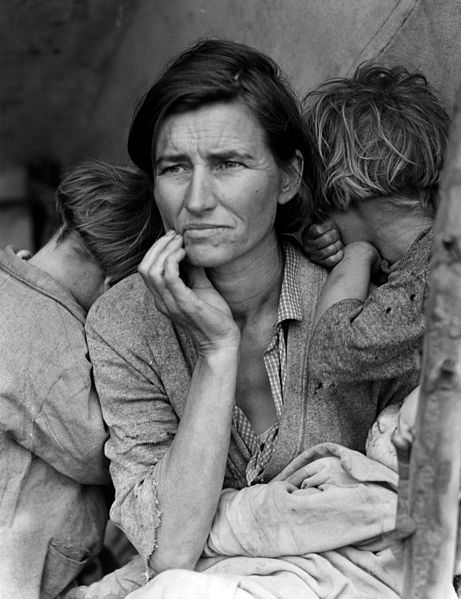
Once again, I recommend Out of the Dust by Karen Hesse. It's an incredible Newberry Award winner for Young Adults that left me in tears at times. It is a well-written, quick read that really helps you to exerience the Dust Bowl of the 1930's.
Wednesday, February 08, 2012
Historical Fiction and Nonfiction for Children
Since the best way to become a writer is to 'read, read, read!", we are sent to a library or bookstore for basically every lesson. The lesson I just completed was about historical fiction and nonfiction and I wrote a lengthy post about some of what I'd found during my trip to the library. I thought I'd share it in case it might get someone interested in one of the books I review or even gives them insight into the writing process. So, here's my post from class...
I spent a few hours at the library yesterday and had a wonderful time sampling historical fiction books for YA. My surprising favorite was Out of the Dust by Karen Hesse. Why surprising? Well, first of all, I didn't really care for the cover - just an old hoto of a girl in a hat. It looked kind of boring to me. And, secondly, I opened it and discovered it was all written in poetry! Not rhyming poetry, but definitely set up as poems. But, I started reading and was pleasantly surprised!
The topic of the book is the Oklahoma Dust Bowls. I grew up in Oklahoma, so this is a topic I am personally interested in! My husband's grandparents, in fact, lived on farms in Oklahoma during this time. (And, I'm going to have to ask them about it!)
So, the story is told from the point of view of a 13 year old girl named Billie Jo. She gets upset because some of the neighbors are having a contest to see who can kill the most rabbits because the rabbits are damaging their crops. But Billie Jo says that "grown men clubbing bunnies to death" makes her sick. But, she's glad they gave the rabbit meat to families that really needed it.
Later, she's asked to play the piano for an event, and she dreams of going to DC someday and playing for President Roosevelt. And, another section talks about meal time...how they set the table with the plates and glasses upside down and the napkin over the silverware and they don't turn them over until the last minute - to keep the dust away, of course! But, Daddy comments that the "potatoes are peppered plenty tonight" and likes his "chocolate milk" for dinner, when really they are both just the result of dust.
The book tells a lot about the dust bown and what life was like for a young girl at this time. And, it is probably a quick read with the short, poetic type chapters that read easily. I'm going to finish this one!
The YA nonfiction book I chose to read was An American Plague: The True & Terrifying Story of the Yellow Fever Epidemic of 1793. Wow! This is an incredible, true story by Jim Murphy and he did a LOT of research! The back of the book includes 13 pages of "sources", many of them with notes! The sources includ books, newspapers, magazines, personal journals, and letters. I liked that he accomplished his research without any interviews...a process that I'm a little intimidated by!
I think the story reads like fiction...just so smooth and you really get into the lives of the 'characters!' It is not stuffy or factual, though filled with researched facts. He includes quite a few quotes, often short ones like a description by a doctor saying the rash "resembled moscheto bites." It makes the story so much more 'real'! And, of course, it is a realy story!
Since nonfiction or historical fiction is what I'd probably like to write, I really loved this lesson. So, I'd love to talk about two more things....
First, I am listening to a lecture series about cathedrals and requested an ILL book at the library for David Macaulay's Cathedral book. I accidentally got a copy of "Building the Book Cathedral." Well, the book tells about how Macaulay wrote the book! His FIRST! It talks about going to a children's publisher with an idea and two drawings...and how they got excited about a totally different story than the one he'd presented. And, he went with it! The story of building a cathedral. Macaulay actually took half of his advance and headed to Paris to do some research. He shows his sketches, his drafts, his first submitted manuscript (which he said looked like a "war casualty" when he got it back.) I think this is a great book to see the process a first-timer went through in getting published!
Lastly, I went to the children's area and found four books that looked intersting by Kelly Milner Halls, one of the authors mentioned in this lesson. The books are "Mysteries of the Mummy Kids", "Albino Animals", "Dinosaur Mummies", and "Tales of the Cryptids."
The first one I opened was the book about dinosaur mummies. The first page is an introduction in which Halls talks about growing up in Friendswood, TX as a little amateur naturalist. She loved finding anoles and watching their tales grow back! Years later, when she was at her first natural history museum, she saw the dinosaur skeletons that reminded her of the lizards she loved as a child. When she grew up to become a writer, she said, she "got lots of chances to dig dinosaur bones with paleo-experts."
At the back of the book, she gives mini-bios of some paleontologists and a lengthy list of resources for kids (or adults!) to look at if they are interestd. Then, she also gives a bibliograhy with a list of books, articles & websites, and "personal interviews and correspondence" that she used to create the book! That's a lot of research!
P.S. I also visited David Macaulay's site and watched a talk he did on TED called "All Roads Lead to Rome Antics", which is the story of how he created his Rome Antics book (above). I thought this was a great video for an aspiring author to write as it gives a lot of insight to all of the ideas he considered and trashed.
I am also watching a video based on David Macaulay's Cathedral book (embeded above). This is a wonderful movie about cathedrals which goes back and forth between the storybook world of Macaulay's Cathedral and real cathedrals with narration by David Macaulay himself. In the cartoon world, there is a great visual of how the heavy arched roofs were made and another section showing how the stained glass windows were created. Although the video is a little grainy, it is a wonderful addition to anyone wanting to learn about cathedrals! And, I believe you can borrow the same video from your library and the quality might be a little better.
Sunday, February 05, 2012
The Boy Who Wouldn't Grow Up
As I was doing more research for our European trip, I came across some information about James M Barrie, the author of the Peter Pan books among other things. I was amazed by his story!
James M Barrie was born in 1860 and was the 9th of 10 children. When James was 6 years old, his older brother, David, died at the age of 13. David was his mother's favorite child, and as James grew up he found it difficult to compete with his brother, David, who was eternally age 13....a boy who never grew up.
After earning a college degree, Barrie moved to London to pursue a writing career. He had a Saint Bernard and would go walking in Kensington Gardens. One day, he met three young brothers. He spent more and more time with them and eventually became like a member of the family. He would make up stories to tell the boys, including two younger brothers later on. The stories centered around a charcter, Peter Pan, who never grew up. (One of the boys was named Peter.) In the stories, Barrie's St Bernard became the 'nanny', Nana. Barrie ended up adopting the five brothers when their parents both died within a few years of each other.
Barrie's first story about Peter Pan was published in 1902. In 1912, Barrie commisioned a statue of Peter Pan to be placed in Kensington Gardens, where he had first told stories about Peter. He died in 1937.
Monday, January 17, 2011
Elements of a Story
Thursday, February 04, 2010
Mr. Barrington's Mysterious Trunk
And the adventure begins...
We are reading a new series of books about Texas history which has us begging for "one more chapter" each day. The series, entitled Mr. Barrigton's Mysterious Trunk, is by award winning author Melodie A. Cuate. The four books in the series are: Journey to the Alamo, Journey to San Jacinto, Journey to Gonzales, and Journey to Goliad.
The story reminds me of the Magic Tree House series, but for older children. In the first book, best friends Hannah and Jackie have just started seventh grade and they have a new teacher, Mr. Barrington. He brings out a mysterious trunk and challenges them to "choose an event in Texas history and become part of it." When he opens the dusty trunk, it is full of books and magazines about Texas. After school that day, the two friends return to the classroom to look in the trunk. Hannah's brother, Nick, joins them and helps them to open the lock. When they look in the chest, it is now filled with memorabilia and figurines regarding the Alamo. Suddenly, there is a crash of thunder and a swirl of dust and the 3 children are transported back in time to the Alamo just days before that fateful battle.
As the children get to know the people of the Alamo fame, the reader learns the history of that important time in Texas independence history. You join the 3 children and become "part of" this historic event.
Tuesday, February 02, 2010
Shakespeare's "Twelfth Night"
I also want to remind you of Jimmie's "Shakespeare for Children" Squidoo. She has lots of great ideas, links, etc!
Wednesday, January 13, 2010
Lessons with Anansi at Story Cove
As I was preparing for this class, I found a site called Story Cove. You need to register, but this site is FREE! They have online cartoon videos of various stories, including a handful of Anansi stories. The stories are sorted by continent, with most of the stories come from Africa and Asia.
The site includes an area for kids to print off coloring pages, mazes, etc. And, it has free LESSON PLANS! Though the plans are mostly for kids in grades PreK-3rd, I found they worked well for my class of 4th & 5th graders. And, the kids REALLY enjoyed the videos! (We ended up watching 4.)
After doing some mapwork of Africa, we watched the video of Anansi & the Pot of Beans. Using the Lesson Plan, we covered:
- similes
- friendly letters
- cause & effect
- acrostic poems
- cooking
- verbs
- fact vs. opinion
- proverbs
- onomatopoeia
Sunday, December 13, 2009
The Goose Club
Tuesday, November 24, 2009
A Christmas Carol
As I sat watching it (my mom & I went to the 2D version while the others saw it in 3D), I remembered the play my sister and I had been in when I was about Alex's age. I played one of Tiny Tim's sisters. (If my mom can find a photo, I'll post it!) Anyway, I was amazed at how I was remembering so many of the lines from the opening scene!
Last night, my niece (11) found a copy of A Christmas Carol at my mom's house. My sister offered to read it for awhile as a bedtime story. We all sat around the living room listening to her... she's a wonderful reader! Anyway, I was really surprised at how closely the movie followed the book - most of the time it was word for word!!!
We only read about 4 (of 47) pages in 20 minutes. They are long, hard pages... but very enjoyable! We had a few questions, like why did it say "Stave 1" instead of "Chapter 1?" And, when Scrooge was talking with the two men collecting for the poor, what was the Treadmill?
I got online today and found The Annotated Christmas Carol which answered both of my questions. It is called a "stave" (an archaic term for staff, a stanza of a poem or a song) instead of a "chapter" because Charles Dickens wanted to continue the "pretense of his story being a 'Christmas carol in prose.' And, the Treadmill was "a mill operated by persons walking on steps fastened to the circumference of a great and wide horizontal wheel." It was a form of criminal punishment. You can see a photo of one here.
Then, today, I was at a homeschool store and came across a barely used copy of A Christmas Carol: The Whole Story. It is an unabridge version with wonderful illustrations and lots of background information, though much less than the annotated version. Many of the illustrations look surprisingly like those found in the Disney movie!
Another great website is found here with more information about Dickens here. This page on the same site is about Dickens & Christmas. Fascinating reading!!!
I'm excited to be learning about Dickens & A Christmas Carol with my sister & our girls. I bought the girls each their own Dover verion today, too. And, you can find online versions at sites like this one which unfortunately uses the word "chapter" instead of "staves."
So, I hope you find a way to enjoy the classic "A Christmas Carol" this holiday season!
Book Review: "The Teacher Who Couldn't Read"
Monday, November 23, 2009
Wonderful "New" Blogs
One of her posts is about a new site that has over 11,000 educational videos. It's called WatchKnow. It links to videos on other sites of the web, but they are pretty well categorized. Alex and I watched a video 'field trip' to the Money Museum in Colorado last night. And, they have A Charlie Brown Thanksgiving posted in 3 parts!
When I really like a blog, I enjoy seeing what that person is reading. You never know when you'll run across another blog you love. And, I wasn't disappointed when I looked at Jill's blogs and came across I.N.K.: Interesting Nonfiction for Kids. This is a blog whose posts are written by children's authors like Loreen Leedy and David Schwartz. Among other things, they talk about their books and speaking in schools.
I really enjoyed the Metric Musings post by David Schwartz, author of Millions to Measure, and Letters...We Get Letters by Susan E. Goodman, author of the Ultimate Field Trip books I just recently heard about and am trying to get from the library.
I hope you enjoy these 2 "new" blogs as much as I am!
Sunday, November 22, 2009
Book Review: A Pearl in the Storm
Monday, October 26, 2009
As You Like It
I would like to watch a movie production of both A Midsummer Night's Dream and As You Like It. Does anyone have any recommendations? I'm wanting something child-friendly. Thanks!
Wednesday, October 21, 2009
A Midsummer Night's Dream
Friday, October 09, 2009
Messages in the Mailbox: How to Write a Letter (Guest Post by Alex)
Saturday, October 03, 2009
Artful Thursday: Cool/Warm Colors & Frank Lloyd Wright
Thursday, June 18, 2009
Massachusetts Authors
So back to the book... one of the activities was a word search using the last names of famous Massachusetts authors. I was excited that Alex recognized quite a few of them and I was telling her about others. Then, I decided to "test" us and see who we recognized. In case you want to play along, here's the list:
Louisa May Alcott
Anne Bradstreet
William Cullen Bryant
John Cheever
Emily Dickinson
Ralph Waldo Emerson
Benjamin Franklin
William Lloyd Garrison
Nathaniel Hawthorne
Henry James
Henry Wadsworth Longfellow
Amy Lowell
Herman Melville
Theodore Geisel, aka Dr.Suess
Henry David Thoreau
Phillis Wheatley
John Greenleaf Whittier
Here's Alex's list:
Louisa May Alcott - "Little Women" & "Little Men" (Yeah, Alex!)
Emily Dickinson - poet (Yes!)
Benjamin Franklin - wrote an almanac
Dr. Suess - The Me Book
Phillis Wheatley - she was a slave - wrote poems (I was the most excited that she recognized this lady! She said she learned about her from the Liberty Kids DVDs.)
My list:
Louisa May Alcott -"Little Women", "Little Men"
Anne Bradstreet - not familiar - looked up here - she was a poet in the mid 1600's
William Cullen Bryant - familiar - looked up here - poet & long time editor of New York Evening Post
John Cheever - not familiar - looked up here - novelist, but best known for short stories
Emily Dickinson - poet - wrote "I'm Nobody Who Are You?" - my high school English teacher's favorite poet :-)
Ralph Waldo Emerson - poet - looked up here - I should have remembered him more for his essays & philosophy of Transcendantlism, from the same English teacher
Benjamin Franklin - Poor Richard's Almanac, letters as "Silence Dogood"
William Lloyd Garrison - not familiar - looked up here - best known for radical abolitionist newspaper, "The Liberator"
Nathaniel Hawthorne - "The Scarlet Letter" (read in same English teacher's class) & "The House of Seven Gables" - I mainly remember this from SEEING this house while visiting Massachusetts as a child
Henry James - not familiar - he is primarily known for a series of novels portraying the encounter of America with Europe
Henry Wadsworth Longfellow - poet - "The Children's Hour" - I LOVED this poem as a child and memorized it for a presentation - I can even remember the little red book I learned it from
Amy Lowell - not familiar - poet who won Pulitzer Prize for Poetry posthumously
Herman Melville - "Moby Dick" (I should have remembered "Billy Budd", too - we have an audio CD in the car) - I even mentioned "Moby Dick" yesterday!
Theodore Geisel/Suess - "Green Eggs & Ham"
Henry David Thoreau - "Walden" - same English teacher! (Oh, and I had her 2 years - 10th & 11th)
Phillis Wheatley - slave/poet
John Greenleaf Whittier- familiar - Quaker poet & a "Fireside Poet" - so now, of course, I want to learn about the Fireside Poets :-)
Overall, I was happy with what we remembered. But, I also realized that we are not learning much poetry or about many poets. So, I hope to fix that this year! We'll start by reading a book about Emily Dickinson I've had on our bookshelf - "The Mouse of Amherst" by Elizabeth Spires. It's about a mouse that lives with Emily Dickinson.
Wednesday, June 17, 2009
Unplug Your Kids: Slippery
Ivory has its own site, with patterns, showing you how to carve the soap. We really enjoyed it and it was challenging, but I thought it turned out well. I used one of the patterns while Alex created her own design.
BOOK REVIEW: I've also been meaning to mention a book I read about whaling while in Maui. The book is In the Heart of the Sea: The Tragedy of the Whaleship Essex by Nathaniel Philbrick. (He also has a juvenile version titled Revenge of the Whale: The True Story of the Whaleship Essex, which is also available on CD.)
The book tells the amazing story of the whaleship Essex which was attacked by an angry whale. It sunk and the crew did everything they could to survive, even taking the most drastic meaures. In the end, only a few of the crew survive the 90 days at sea. The book is indeed intense and mezmerizing and this true story inspired Herman Melville to write Moby Dick.