Showing posts with label history. Show all posts

Thursday, December 05, 2013

Nat Turner Rebellion

Tomorrow we will study the Nat Turner Rebellion using three online resources:

image from Wikipedia

  1. We will read "Nat Turner's Rebellion" at a PBS site under "Brotherly Love".
  2. We will use the Stanford History Education Group's site  Nat Turner lesson plan to "read like a historian". We will read and discuss parts of three documents, including Nat Tuner's "Confession". (You can view the lesson plans after registering which is free.)
  3. We will watch the short Bio video about the slave rebellion.

Thursday, November 07, 2013

The Constitutional Convention

Today we will be finishing up our study on the Constitutional Convention using the following three sites:

First, we will listen to "The Constitutional Convention of 1787 for Dummies by Keith Hughes. We have watched several of his videos and I think they are great!


Then, we will play "The Constitutional Convention" at Anneburg Classrooms. (Note that when it asks you to login you push "cancel" and you will be able to play.) This game says: "Travel back to 1787 and become a delegate to the convention in Philadelphia. As the Founding Fathers struggle to decide how the young nation will be governed, explore how very different men representing their states' conflicting interests created a bicameral legislature and three branches of government."
 
 
And, lastly, we will play Constitutional Convention Jeopardy at the Super Teacher Tools site for a review. You can also play this on your iPad or other non-flash device. Whichever way you play, the scoring is awkward. But, I think it is worth it for a good review game!

Thursday, October 10, 2013

The Constitution & the Bill of Rights

This year we are using the Colonial Williamsburg Electronic Field Trips which we bought through the Homeschool Buyer's Co-op.  The first show was today, though they are recorded and you can watch them anytime throughout the school year. I highly recommend them!
 

We started out by reviewing the Articles of Confederation and the Federalist vs. Anti-Federalist compromise while creating the Constitution.


We started with this video about The Making of the American Constitution. You can also watch the video on this TED ED site. It also has multiple choice questions about the video and a "Dig Deeper" section. 


Next, we watched this short video titled "Federalists vs. Anti-Federalists: A Compromise." Then, we did all of the activities that were included in the CW EFT. The two major components were summarizing the 10 amendments and then reading about cases and documents and determining to which amendment they corresponded.
 
Tomorrow, we will actually watch the presentation as we spent two hours doing these videos and activities. I found two more videos I'd like to use...
 

A 3-minute Guide to the Bill of Rights, which is also from TED ED and therefore also has multiple choice questions and a "Dig Deeper" section.


And, "The Bill of Rights Hand Game: US History Review" by Keith Hughes. I have watched several of his videos and really enjoy them. This particular one is to help you remember the first 10 amendments that appear most often on a particular test and Mr Hughes uses hand 'signals' to help you remember what each of them mean.

As I've been teaching Alex again this year, I'm just amazed at all of the available resources! A lot of teachers now "flip" their classrooms and you can find some wonderful videos to explain difficult concepts! 

Tuesday, September 03, 2013

Learning Through Movies: Nelson Mandella & Apartheid

We were at a restaurant last night and saw on the news that Nelson Mandella had been released from the hospital. My husband started explaining to Alex who he was and then told her he knew of a great movie that would teacher her a lot about him, South Africa, and apartheid. She knows 3 sisters (triplets!) from South Africa, so this would seem more 'real' to her.


The movie is by ESPN and it's a 30 for 30 film called "The 16th Man". It's the story of how Mandella used the sport of rugby to unite his country after becoming president. It's an amazing story! (My link is to YouTube, but it is also available on Netflix.)

Wednesday, April 10, 2013

The Guns of Lexington

I've been watching a lecture video series by Dr J Rufus Fears on YouTube. It is called "The Story of Freedom". I have been learning so much and wanted to record some of that on my blog both for my own review and perhaps others would enjoy my insight, links, or even the original video.


The first video is titled "The Guns of Lexington" and covers some of the early events in the Revolutionary War. From my notes and put in my own words...
 
On April 19th, 1775, the British elite were stationed in Boston. A rebellion was starting and Governor Sir Thomas Gage was under orders to put down the rebellion. He was given a two-part mission: to arrest John Hancock and Samuel Adams (in Lexington) and to capture some of the weapons the colonists were stockpiling.
 
Marching under Sir Francis Smith, about 700 Red Coats sat out in the middle of the night on a 20 mile march. There were two locations where they knew weapons were being stored - Wooster and Concord. If they were going to go to Wooster, they would travel the entire way by land. But, if they were going to Concord, they would launch boats and travel part of the way by sea. Thus, the famous saying "One if by land; two if by sea." And, they went by sea... towards Concord.
 
Now, these colonsits were British subjects! But, cannons were weapons of mass destruction and there was no need to be in possession of them... except for war! As the Red Coats approached, they expected to see dark, sleeping villages. Instead, they were greeted in Lexington by 77 colonists who had been warned (becaues of spies like Paul Revere and Samuel Adams) that "the British are coming!" This was at about 4:30 in the morning, and as the 700 British soldiers faced the 77 colonists, a colonist leader (Parker) said "Stand your ground! Don't fight unless fired upon! But, if they want to have a war, let it begin here." Then, someone, no one knows who or on which side, fired "the shot heard round the world."
 
Eight colonists, British subjects, were killed! The Red Coats headed down the road towards Concord. Now, they needed to find cannons to justify the spilling of British blood! While they leave 98 British to dismantle the Old North Bridge, the rest march into Concord and search for weapons. But, they've been removed and so they can't find any!
 
By noon, hundreds of minutemen from nearby towns arrive. They start shooting at and killing the British soldiers who begin a retreat to Boston. Even though the Red Coats receive backups near Lexington, the colonists continue to follow them all the way to Boston... shooting and killing... They are now a force about 16,000 colonists strong.
 
When the Red Coats reach Boston, the minutemen surround them and put them under siege. A British General, William Howe, decides he needs to get some cannons on top of some of the hills in Boston so he can fire down on the colonists surrounding the city. But, during the night, the colonists take Bunker Hill and Breeds Hill.

File:The death of general warren at the battle of bunker hill.jpg
The Death of General Warren at the Battle of Bunker's Hill, June 17,1775 by John Trumbull at Boston Museum of Fine Arts(from Wikipedia)
 
Twenty two hundred Red Coats march up the hill in rows of three. Knowing the colonists weapons will shoot farther than the Red Coats, Prescott (a colonist) says "Don't fire until you see the whites of their eyes!" The British in their formations are heavily attacked. They make several charges and eventually take off their heavy red coats. They have some cannons, but they have the wrong sized cannonballs! Eventually, though, the colonists run out of ammunition. Half of the British soldiers are dead or wounded.
 
Meanwhile, the Continental Congress is meeting in Philadelphia. They have decided that they are at war and need troops and a leader. On July 1, 1775, General George Washington takes command of the troops under an elm tree in Cambridge, Massachusetts. Now, the colonists are at war with the British.


Other resources:
  • A poem by Emerson (1803-1882) coins the phrase "the shot heard round the world" and is sung at the Concord Monument on July 4, 1837
  • "America: The Story of US" has a 12 minute clip about Lexington & Concord
  • Liberty's Kids has an episode called "The Shot Heard Round the World"
  • Johnny Tremain, both the book (which I haven't read) and the movie (which I watched last week on Amazon Instant Video) are about these events & more
  • Visit the Paul Revere Heritage site to read Longfellow's "Midnight Ride" poem and learn about some of the myths from this poem

Wednesday, February 13, 2013

Jesse Owens & Hitler

I am currently listening to A Book Thief by Markus Zusak. The book takes place in Nazi Germany during WWII. In the part I just listened to, we visit 1936 where a young boy is fascinated by the black Olympian, Jesse Owens.

The chapter is called "The Jesse Owens Incident" and the young boy, about 7 years old, paints himself black with charcoal and pretends he is Jesse Owens winning a gold medal. His father finds him and scolds him for pretending to be black. He should be happy with his blonde hair and blue eyes... especially as they live under the watchful eyes of Hitler who believes the Aryan race is supreme. In fact, the Olympics were supposed to showcase the supremecy of the Aryans, and yet 6 gold medals were won by black American athelets, including 4 by Jesse Owens. Hitler stormed out of the stadium after Owens won the 100-meter event.


I found this brief video about Jesse Owens on Biography.

Tuesday, February 12, 2013

The Siege of Leningrad: A Book Review & A Young Girl's Diary

After reading The Bronze Horseman by Paullina Simmons, a historical fiction book about the siege of Leningrad, I was interested in learning more about this time in recent history. I found this Kindle book called The Siege of Leningrad by Rupert Colley which is part of a series called "History in an Hour." It really had some good information in it and was interesting to read.

The Siege of Leningrad: History in an Hour
 
 
The Introduction to the story is powerful. I've included several pieces below:
 
The Fuhrer has decided to wipe the city of Petersbury from the face of the earth. After the defeat of Soviet Russia there is no interest in further existence of this large inhaabited area. - Adolf Hitler
 
With these words, issued on 22 September 1941, Adolf Hitler effectively sealed Leningrad's fate.
 
The number of deaths in Leningrad exceeded those who died from the atomic bombs at Hiroshima and Nagasaki combined, and constitutes the largest death toll ever recorded in a single city.
 
While being surrounded for almost 900 days... over one million died... from German bombs or artillery, or from disease, the cold or starvation.... The story of the siege is one of heroic resistance and stoical survival but is also one of unimaginable suffering and extreme deprivation.
 
 
After telling about the siege, the author tells about some of the people of the siege. One of them, Tanya Savicheva, was a young girl who kept a diary. She was 12 years old when she started writing in her diary. But, with the intense cold and lack of fuel, her diary became fuel along with their household furniture. Tanya was eventually evacuated in August 1942, but she died of tuberculosis on July 1st, 1944. Her nine surviving diary pages tell of the deaths of her family members:
 
Zhenya died on Dec. 28th at 12:00 P.M. 1941
Grandma died on Jan. 25th 3:00 P.M. 1942
Leka died on March 5th at 5:00 A.M. 1942
Uncle Vasya died on Apr. 13th at 2:00 after midnight 1942
Uncle Lesha on May 10th at 4:00 P.M. 1942
Mother on May 13th at 7:30 A.M. 1942
Savichevs died.
Everyone died.

Only Tanya is left.


Sunday, January 13, 2013

Visiting the Bayeux Tapestry & Bayeux, Normandy

We made the small town of Bayeux are headquarters for several nights while in Normandy.


This is a view of our cute hotel! There are two rooms per floor, and Alex & I were on the second floor on the right in this photo (our left window is open). It reminds me of the children's book, Madeline... "In an old house in Paris covered in vines..."


There were actually three separate buildings and behind one of them was this gorgeous garden. We sat out here one evening and had drinks - you had to buy off the menu to come out here. We also had very nice buffet breakfasts while staying here. (I'll have to look up the name.)


The Bayeux Cathedral reaching up to the sky!
 
 
Another view of the Bayeux Cathedral. We went inside, but I don't feel my photos do it justice!
 
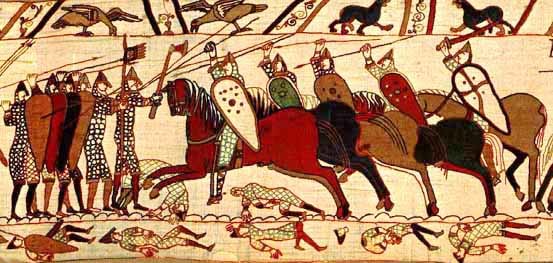
File:Normans Bayeux.jpg
from Wikipedia

One of the highlights of Bayeux is the famous Bayeux Tapestry. Unfortunately, though I understand why, you are not allowed to take photos of the tapestry. So, these photos are from Wikipedia. This tapestry depicts the Norman Conquest of England by William the Conqueror in 1066.
File:Edward der Bekenner.jpg
from Wikipedia
The "tapestry" is a misnomer and is actually embroidered cloth. It measures about 230 feet long and tells the story in cartoon like images. I wrote a lot more about the tapestry here.
 
 
As we walked around Bayeux, we enjoyed the sites - like this waterwheel. Inside the building on the left was a shop where we bought a few souvenirs.
 
 
And, we loved this cat sitting on the ledge of a second story window - though we were nervous, too!

Saturday, January 12, 2013

Visiting D-Day Sites in Normandy: American Cemetery

Our 3rd stop on our half day tour with Eva was the American Cemetery. When you are on the cemetery grounds, you are standing on American soil!


To get to the cemetery from the parking lot, you walk down a wooded path.
 
 
Then you entered "The Garden of the Missing". On these walls are listed "the missing in action who gave their lives in this region." If I remember correctly, they were separated by branch of service.
 
 
In cases were remains were later recovered, identified and buried, a bronze rosette is placed beside the name. As you can see, besides the name of the missing, you'll also find their rank, unit, and state from which they served.
 
 
Then you enter the memorial. In the center is a statue. On either side is a map - this one is titled "Military Operations in Western Europe: 6 June 1944-8 May 1945."
 
 
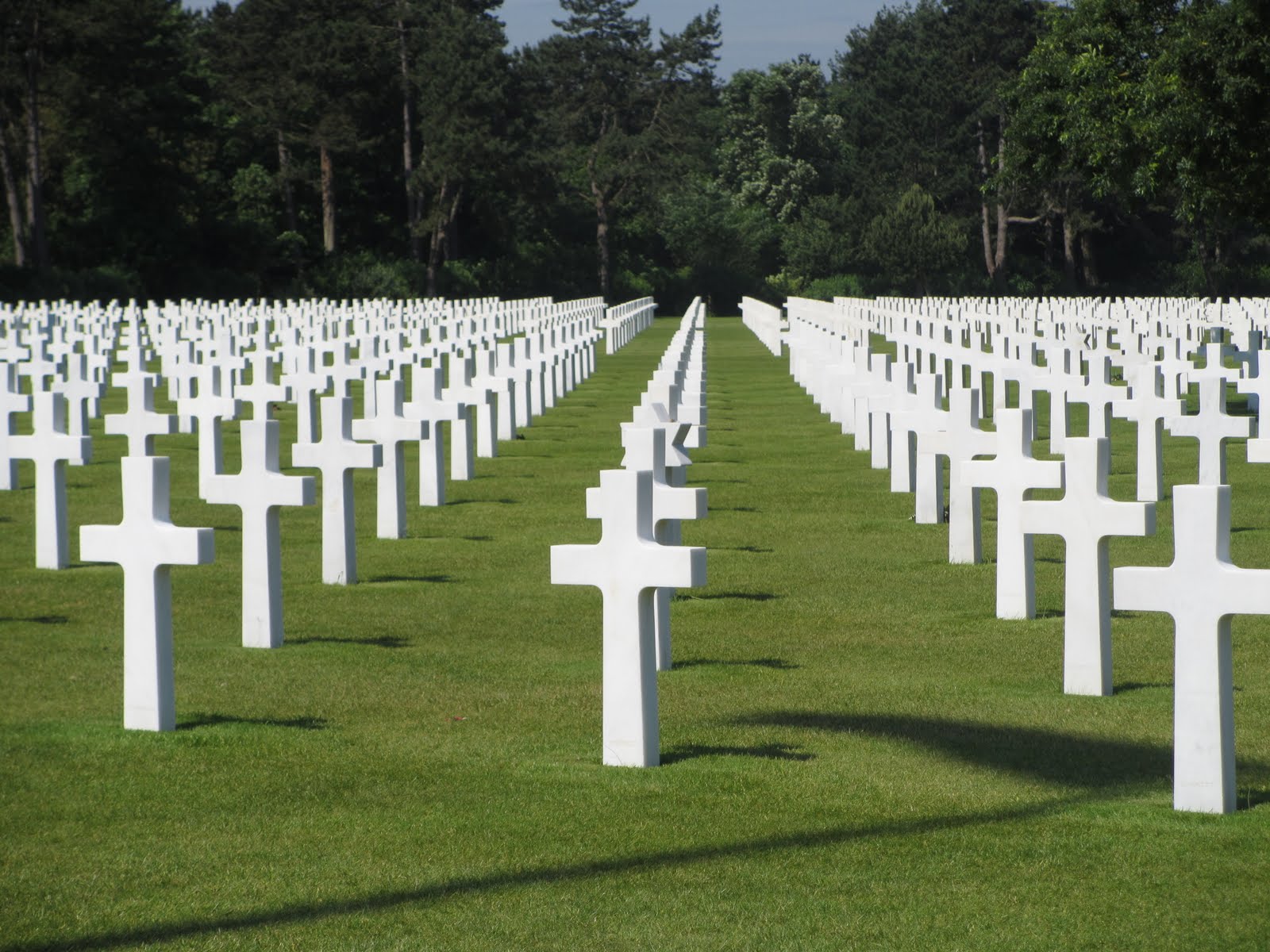
Walking out of the memorial, you get your first glance at the headstones. Usually, there is a reflecting pond here, but it was drained at this time and a man was working in ti.
 
 
The cemetery is divided into 10 plots with a central path. The headstones are made of white marble with Latin crosses and Stars of David. Although the families of those Americans killed in this area were given the choice to have their remains moved home, many chose to have their bodies remain here... on the land they fought so hard to free.
 
 
This is a grave of an unknown soldier. It says "Here rests in honored glory a comrade in arms known but to God."
 
 
There are also women buried in the cemetery. Elizabeth A Richardson served with the American Red Cross and died June 25, 1945.
 
 
A Star of David headstone for a Jewish soldier. I first saw the stones placed on these graves at Arlington Cemetery in Washington, D.C.
 
 
In a second building, the chapel, there was this mosaic ceiling. According to the American Battle Monument Commission brochure, it depicts "America blessing her sons as they depart by sea and air" on the left and "a grateful France bestowing a laurel wreath upon the American dead" on the right.
 
 
From the edge of the cemetery, you can see how it overlooks Omaha Beach. Some of the soldiers who died on D-Day were originally buried at the beach but were later moved to this cemetery.
 
 
Lastly, I want to recomend 4 videos that are shown at the cemetery's visitor's center. The first is a two minute video about the cemetery itself titled "Normandy American Cemetery." The second is title "Letters" and you meet some of the soldiers who are buried here through letters, home photos & videos, and learning more about their lives before the war and when they died. This one really had me crying! The third is called "On Their Shoulders" and it tells the specific stories of 3 men who were killed - another very moving video. And, the fourth is "OK, Let's Go" about Eisenhower's decision to launch Operation Overlord on June 6th. Another touching film! You can find all four videos at the American Battle Monuments Commission site.

Visiting D-Day Sites in Normandy: Omaha Beach

After visiting Pointe du Hoc, Eva, tooks us on the short trip to Omaha Beach. I watched an incredible movie title Surviving D-Day and I'll use it for some of my facts. Again, Eva shared so much with us! But, I didn't write it down and have forgotten a lot of it.

 
The drive to the beach takes you past a little community of rental property. At the top of these cliffs which overlook the beach, you can see two openings (in top, bare area near center left) where Germans hid and shot their guns. As the Allies made landfall, many of them believed they would not survive. And, many didn't. Four hours before the landing, Allied planes dropped 13,000 bombs intending to knock out much of the German resistance. The Allies had bragged about their accuracy. But, there were low clouds and the planes were forced to use new radar equipment. To protect the Allied ships in the English Channel, orders were given to wait 5-30 seconds after getting to where the airmen though the target. The planes dropped their bombs too late, and not a single one of the 13,000 bombs hit the targets!

(outside of museum near Omaha beach which we unfortunately didn't have time to visit)
When the landing craft opened the doors to let the soldiers attack the beach, many were shot immediately. The open doors were a target for the incredible MG42's of the Germans. These machine guns could shoot 25 bullet per second! Many who survived did not go through the opened gate, but jumped over the sides of their landing craft. Many of these drowned in their heavy gear. And, many were seasick because of the huge breakfast they'd eaten. When they reached the beaches, there were obstacles like these hedgehogs in my photo above. These had been placed on the beach to prevent a high-tide landing by the Allies.


Besides the machine guns, the Germans also fired with these artillery. This one overlooks the beach and is behind a heavy fence. The beach, when the Allies landed, wa 1000 feet long - or 3 football fields long. Besides the machinegun fire, artillery fire, and obstacles like the hedgehogs (which could also be used to hide behind somewhat), there were over 17,000 mines!
 
 
We visited at high tide and didn't actually step foot on the beach, which I regret now. The tide was going out and we aw a few people on the beach later. As the Allies fought to take the beach, the tide came in squishing the surviving soldiers together.


After capturing the beach and losing over 2,000 soldiers, the Allies would build a man-made harbor called a Mulberry Harbour. But, about 10 days later, a storm came up and destroyed this harbor. This is part of the remains of that structure.


As we left Omaha beach, we drove past this monument which says: The Allied forces landing on this shore which they call Omaha beach liberate Europe June 6th 1944. Surrounding the monument are 8 flags. It was noon, and they were having a flag raising ceremony! The flags were raised one by one while the national anthem of that country was played.


The raising of the United States flag was a very moving experience. I'm glad my mom 'insisted' that we stopped as we were ready to drive on by! I was, and am, proud to be an American! Thank you to those who serve in the military to defend us and defend freedom!

Friday, January 11, 2013

Visiting D-Day Sites in Normandy: Pointe du Hoc

June 6th, 1944. The Germans occupied France and much of Europe. The Allies began their D-Day invasion to recapture the continent.

We booked a private half-day tour of the American sector sites of the D-Day invasion in Normandy. Our guide, Eva Ruttger with Experience Normandy, was FANTASTIC and obviously loved what she did. She told us the amazing story of the invasion and even had photos and maps to share with us. I wish I'd taken notes as I've forgotten a lot of what I learned! But, what I took away was the incredible planning that went into planning the invasion.


Alex, my mom, me, my brother & his girlfriend in front of a pillbox that would have housed a 'big gun'
This is a picture of us outside of one of the bunkers at Pointe du Hoc. The bunkers are where the Germans kept their 'big guns' which could shoot 10-12 miles and hit the ships at sea. Eisenhower wanted to make sure these guns were destroyed. Pointe du Hoc supposedly had five of these guns at this Pointe which overlooks Omaha Beach. Troops were supposed to land at 6:30 a.m. at Omaha Beach and the guns were supposed to be inoperable by then.


Alex, me & my brother standing in a crater at Pointe du Hoc- you can see a 'pillbox' in the background
American planes sent planes to drop bombs in the area of Omaha Beach. This was to clear a way for Allies when they landed. Because of bad weather, the targets were missed and Omaha Beach did not have any bomb craters where the soldiers could have hidden as they landed. But, here on Pointe du Hoc, there were craters.


After crossing the English Channel from England, the Rangers had to scale these 100 foot tall cliffs of Pointe du Hoc. While landing on the narrow shore and climbing the cliffs, they were being shot at and having gernades thrown down on them. There's a great, 9 minute clip from The Longest Day which shows this scaling and shows the very places I've photographed and visited.

Part of a monument at the site
Here is a quote by President Reagan on the 40th anniversay of D-Day: June 6, 1984:
The Rangers looked up and saw the enemy soldiers - the edge of the cliffs shooting down at them with machineguns and throwing gernades. And the American Rangers began to climb. They shot rope ladders over the face of these cliffs and began to pull themselves up. When one ranger fell, another would take his place. When one rope was cut, a ranger would grab another and begin his climb again. They climbed, shot back, and held their footing. Soon, one by one, the rangers pulled themselves over the top, and in seizing the firm land at the top of these cliffs, they began to seize back the continent of Europe. Two hundred and twenty-five came here. After 2 days of fighting, only 90 could still bear arms.

This is a relief map from that monument. The water (closest to us) is the English Channel. The The part that sticks out is where Pointe du Hoc is located. On the left side of the photo is another American invasion site: Omaha Beach. On the right is a British invasion point: Utah Beach.


Here's a photo I took from near the tip of Pointe du Hoc. If you could see down below, you'd be able to see Omaha Beach.


Our wonderful guide is on the left - I'll have to look up her name and the name of her company. She was incredible! Anyway, this is also taken at the tip of Pointe du Hoc but looking away from Omaha Beach.


I'm standing inside of a bunker at the very edge of Pointe du Hoc. From this point the Germans could watch over the seas. The opening was maybe 2 foot tall and arched almost 180 degrees. There were also a couple of rooms in this structure where the troops must have lived or spent a lot of time. There were bullet holes in the walls from when the Allies captured this Pointe.

From here, we traveled to Omaha Beach... which will be a separate post.

Note: I got some of my information from the American Veterans site on a page titled "The Guns of Pointe du Hoc."

Saturday, January 05, 2013

Book Review: Tatiana and Alexander by Paullina Simons

Tatiana and Alexander is the second book in the trilogy that started with The Bronze Horseman. I finished the first book a few days ago and immediately downloaded the second book to read. I had to know what happened next! (As I mentioned in my review of The Bronze Horseman, this book also has a lot of sexual content. However, this time a lot of it is in the italicized sections and I ended up just skipping page after page of this and the book still totally made sense. )

 
When this book starts, Tatiana has escaped to the United States and is about to have Alexander's baby. She left Alexander behind, believing him to be dead. As she tries to make a new life for herself, she is haunted by the thought that maybe her husband isn't dead after all.
 
 
Alexander, meanwhile, is still alive and fighting for his life. At times he acts as a ranked soldier again, while at other times he is imprisoned. He holds on to the belief that Tatiana is alive and well and tries to survive Stalin's "death machine" and find Tatiana.
 
The Registration Room on Ellis Island. Tatiana lived & worked on the island. My photo from our 2008 trip.
A lot of the story of Tatiana as she lives in NYC and is about her waiting and trying to decide if Alexander was really alive or not and whether or not she should go on with her life. This actually got a bit boring. And, as she was in the United States she was learning English and we had to read her conversations in broken English. I think this was confusing because it didn't 'sound' like the voice of Tatiana that I was accustomed to.
 
File:Sachsenhausen2.jpg
Sachsenhausen NKVD Special Camp (controlled by Gulag) in Germany where Alexander was held
photo from Wikipedia
Alexander's story, however, was more exciting. Not only was there more of the war and the 'history' (which is what I love about historical fiction!), you also learned more about his life as a child. Some of this was really interesting (including his life in the Gulag which I'd studied and read about last year), and other parts were disturbing. I came away not liking Alexander near as much after reading this book.
 
So, I'm happy to finish this trilogy after the first two books, but won't be reading the third. I gave this book 3 out of 5 stars.


Book Review: The Bronze Horseman by Paullina Simmons

I read The Bronze Horseman because I love reading about Russian history. It was quite a lon book at over 800 pages! But, I really enjoyed it... though I also had some issues with it. Well, one particular issue. The book contains a lot of sexual content. I've never read a Harlequin Romance book, but I can't imagine they could be much worse (both in amount and detail). It was ridiculous. However, the story and the history were wonderful.
 
The book starts in Leningrad  in 1941 on the day when the government announced that Hitler had broken the Nazi-Soviet Non-Aggression Pact and invaded Russia. Tatiana, a young girl just shy of 17, is sent to buy up all the food she can while her family sends her twin brother off to a boy's camp where they hope he'll be safe. Tatiana doesn't sense the urgency and by the time she starts looking for food she can't find what the family needs. But, she is helped by a handsome stranger -  a lieutenant in the Red Army.
 
File:RIAN archive 216 The Volkovo cemetery.jpg
3 men burying victims of Leningrad seige from wikipedia
The story continues to unfold as Leningrad becomes under siege: the infamous Siege of Leningrad which goes on for 900 days as the Russians bomb and attempt to starve the residents of the city. From Wikipedia: Civilians in the city suffered from extreme starvation, especially in the winter of 1941–1942. For example, from November 1941 to February 1942 the only food available to the citizen was 125 grams of bread, of which 50–60% consisted of sawdust and other inedible admixtures, and distributed through ration cards. For about two weeks at the beginning of January 1942, even this food was available only for workers and military personnel. In conditions of extreme temperatures (down to −30 °C (−22 °F)) and city transport being out of service, even a distance of a few kilometers to a food distributing kiosk created an insurmountable obstacle for many citizens. In January–February 1942, about 700–1,000 citizens died every day, most of them from hunger. People often died on the streets, and citizens soon became accustomed to the sight of death. This time period is graphically portrayed in this book.
 
My photo of Stalin statue in Estonia, 2012

While we follow Tatiana going through the seige of Leningrad, we follow Alexander as he rises through the ranks of the Russian army. Stalin was an incredibly harsh leader who let so many of his people die - both as soldiers and citizens. I talked more about Stalin at this post.
 
I gave the book 4 out of 5 stars. I would have given it 5 if it weren't for the sexual content. You can always flip through these pages and enjoy a wonderful historical story!

Saturday, December 01, 2012

The Cuban Missile Crisis

I read Stephen King's 850 page book this week, 11/22/63. The book is primarily about a man, Jake Epping, who travels back in time to try to stop the assassination of JFK. But, Jake enters the past in 1958 so, along the way, he tries to do a few other good deeds.

While I was reading on Monday, and Alex was home sick, I came across a part of the book that dealt with the Cuban Missile Crisis. This is a subject that I wasn't very familiar with, so I started looking online. I found a movie from 2000 titled Thirteen Days and Alex and I both watched it and learned a lot about this scary time in American history! You can find the movie on YouTube. I also have started (and will try to finish today) a History Channel documentary called Declassified: The Cuban Missile Crisis, which you can also find on YouTube.


(Part 1 of 2)
 
As far as Stephen King's book... this was my first book to read by him and I REALLY enjoyed it! The book was full of surprises and I never new what was going to happen next. Warning: the book contains quite a bit of cussing and a few 'bedroom scenes'.

Saturday, July 14, 2012

Seeing Lenin & Stalin

I'm going to skip ahead on our trip because I watched a movie about Stalin over the past two days. Besides France, we were able to visit three other countries: Finland, Estonia and Sweden. While in Estonia for three days, we went on a semi-private tour (7 people of which we were 5) of occupied Estonia. One of our stops on the tour was a pile of old statues behind a museum - primarily statues of Lenin, Stalin, and some soldiers.
our family with statues of Lenin and Stalin in Tallinn, Estonia
We took some photos of all of us around a statue of Lenin. To tell the truth, at the time I didn't know which statues were Stalin and which were Lenin. We were smiling and that later disturbed me. Would we have been smiling around a statue of Hitler? Is it because we don't understand the horror of these men? Maybe. But, as I thought more about it today, I realized that we were primarily smiling because of where we were... we were standing next to a piece of history. And, these statues weren't terrorizing people any more... they were piled up and neglected and no longer a threat. The people of Estonia are FREE!
my photo of Stalin statue in Tallinn
The History Channel documentary I just watched (online) is called "Stalin: Man of Steel." It was an amazing tale of a ruthless man who led to the death of millions of his people... but was strangely still their beloved Father. At the end of this post I'm going to share some of the notes I took - many of them actual words from the movie. But, if you are interested in learning more about him, I recommend this movie.


My notes:

The Romanov's had ruled Russia for over 200 years and it was the goal of revolutionaries, including Stalin, to overthrow them. On October 25, 1917, the Bolshevik's stormed the winter palace in St Petersburg and the Tzar was toppled. Lenin became the new leader of Russia. (Question: did Lenin take power immediately?)

Stalin worked as an enforcer in the Communist party during the next five years and was then elected General Secretary. Eventually, he became Lenin's right hand man. When Lenin died in 1924, there were two possible successors: Stalin or Trotsky. Congress went against Lenin's will and chose Stalin and exhiling Trotsky (who would be later assassinated under Stalin's orders).

Stalin, wanting only loyalty to himself, banned the Russian Orthodox religion and had all religious materials destroyed. He had the churches destroyed and thousands of priests executed. Then, he set himself up as a new god... and his image hung in every home.

Russia was a land of peasants and swamplands, but Stalin started industralizing building major factories and railroad tracks. Then, he took all of the agricultural land and created "collectives" - giant state-owned farms. The farmers who refused to deliver their harvests were subject to violence.

By 1932, modernization was taking its toll on the rural population. As 5 million people starved, Stalin had 5 millions TONS of grain exported! But, life in Moscow was good... if you followed the party lines!

A wave of political execution  followed with neighbors turning against neighbors and quotas set for how many people needed to be killed. Troika (groups of 3) went around conducting brief trials before executing people. In two years, 1.5 million people were killed.

Kolyma Goldmine from Wikipedia
Even as millions of people died in the Gulags, the prisoner's put their trust in Stalin. They thought he didn't know what was going on and would save them if he only knew. They thought he was a saint. In the Kolyma Gulag, a camp where gold was mined, the death rate was nearly 100%.

In the late 1930's, Stalin ordered a purge of his fellow party members and military leaders. He had 8 of his top generals executed and over 30,000 officers were killed over the next two years. Stalin wanted to raise up new leaders who would be faithful only to him.

In 1939, Hitler and Stalin signed a non-agression pact, the Molotov-Ribbentrop Pact. But, on the 22nd of June, 1941, Hitler ignores the pact and attacks Russia. The Red Army is surprised and suffers heavy losses. The Soviet people fight for the Motherland and for their beloved Stalin.

Russia suffers massive losses, until winter sets in and they are able to save Moscow. Leningrad, however, is under seige by Germany for 900 days and over 1 million people die.

Yalta Conference from Wikipedia
Stalin had been pushing the Alllies to start another front, but that didn't come until June 6, 1944... D-Day. In 1945, the Yalta Conference takes place in the Crimea with Stalin, Roosevelt, and Churchill. Stalin demands control of German territories in the East and the other leaders, tired of war, concede.

In April 1945 the war is basically over, but Stalin pushes his army hard to be the first to reach Berlin. He sacrifices hundreds of thousands of soldiers and his officials discover the body of Hitler in his bunker. However, he keeps this information top secret. Russia is now a Superpower and Stalin is a hero.

The Postdam Conference takes place in July of 1945 when the leaders of the 3 Superpowers - Stalin, Churchill & Truman - divide territory among themselves.

On March 2nd, 1953, Stalin has a stroke and dies three days later. Russia mourns. Even those who have lost loved ones weep. Stalin has created himself into a mythical being... and he's turned a country full of peasants into a Superpower.
Related Posts with Thumbnails