Showing posts with label Healthy Habitat. Show all posts

Tuesday, July 13, 2010

Summer Critters in the Healthy Habitat

While Alex was at camp at our co-op 2 weeks ago, I walked around and took some photos of the summer critters in our Healthy Habitat.
Gulf Fritilary on Turk's Cap - we also found some caterpillars on a passion vine, but my camera's battery was dying
a cool grub! you can see its hairs and spiracles. i also saw 6 legs. and, this is his tail end...
he proved it to me

a female robber fly - you can tell it's a she by her ovipositor that looks like a stineger

this was very tiny, but i'm pretty sure it is some kind of wasp

a beautiful caterpillar i found on the porch ceiling in the front yard - i just used "what's that bug?" to identify this as a White Marked Tussock Moth.
Here is a description by bug guide: “Caterpillars are recognized by the bright red head and broad black stripe along the back flanked by a yellow stripe each side. Two red glands on sixth and seventh abdominal segments, and four tufts of hairs (which may be white, gray or yellowish) on the first four abdominal segments are common to several members of the genus. CAUTION: Contact with hairs may cause an allergic reaction."

GPS Camp

First of all, thanks again to everyone who is sticking with me through the summer! I really am still having trouble getting motivated to post. And, I'm working out HARD! I'm working towards a 5K in October and a sprint triathlon in April and putting in lots of hours training. I am learning to "run" (jog) and made a new personal best yesterday - I ran for 5 minutes straight! I'm also swimming, cycling, lifting weights, and other types of activities. I'm really feeling great!

Ok... back to the blog! Alex is in a GPS camp at our co-op this week. Well, actually she's home sick today, but we hope she'll be ready to go back tomorrow. (She was vomiting last night, but no fever or other symptoms.) Anyway, yesterday they learned some of the fundamentals regarding longitude and lattitude and satellites. At lunch, he explained to me (and others) some basics about GPS and satellites. Here is some of what I learned:

  • satellites were originally intended for military applications and first launched in 1978

  • there are 30 satellites which each circle the globe every 12 hours

  • GPS receivers compare when a signal was received to when it was sent to determine how far the receiver is from the satellite

  • each satellite has a unique "sound"

  • each satellite is built to last about 10 years, but the oldest currently up is almost 20 years old
Alex's camp lasts 2.5 hours a day. After learning about the GPS systems, they went out on our property (I think it is 4+ acres) to find a site the teacher had programmed. Then, the 3 groups of 3 each were to find a different location where the teacher had hidden a box.

I helped Alex's group and we found this box of goodies. There were instructions telling us how to trail blaze. There were specific instructions, but we basically to use the materials in the box to make a trail (300 paces long!) that the other teams could follow. This proved to be pretty hard for us! One boy on Alex's team led the way and he was out of all of our rocks pretty quickly. We then decided we needed to pick up our rocks and use them more sparingly and mark our team number on them (as other teams would be crossing our path, too). Well, time ran out and we never finished, but we learned a lot! We are both disappointed to be missing today's camp. 

I think today we will watch the following brainpop videos: GPS, satellite, and longitude and latitude. I also borrowed a book from the teacher titled "Let's Go Geocaching" by John McKinney (a DK Reader).

Friday, May 07, 2010

Pollinator LIVE! (a distance learning adventure)

Pollinator LIVE will be hosting a live webcast this Wednesday, May 12th. It is geared for grades 4 to 8 and is the first of a series of live webcasts. This one will be at the National Zoo in Washington, D.C and is titled Insect Zoo in Your Schoolyard. (You do need to go to the site to register, but it is free. And, you can watch a short "test" video to make sure you'll be able to see the live webcast.)


The topics of the day include: Overview of Pollination, Pollinator Partners, "Bee" a Scientist, Monarch Update, and Attracting Pollinators to Your Schoolyard Garden (or, in our case, our home!). There are also broadcasts on other topics planned for September 2010, October 2010, February 2011, and April 2011.

There are also Lesson Plans broken down by age groups which I plan on looking at this weekend. And, if you miss the live class, it will be archived on the Pollinator LIVE site!

P.S. We use BrainPop a LOT and find it to be a great resource, though kind of expensive. They have videos titles "pollination" and "honeybees" that we will watch before Wednesday's webcast. After the movie, they have a quiz, activities, "read more", and Q&A. It'll be a great start to this topic! I also think we'll try to find some pollen to photograph using our digital microscope.

For younger students, you might try this project I used with Alex when she was barely 5. I adapted it from something I read online at Core Knowledge. I cut out petals and filled a container with Cheetos. Then, I drew a bee on Alex's finger. When her bee visited the flower, it came out with pollen on it!

Wednesday, April 28, 2010

Insects in our Healthy Habitat... and a Alex Holds a Baby Opossum!

I had another amazing day walking around the Healthy Habitat on our co-op property. Here are a few of the amazing things we saw:

A horned caterpillar which will become a sphinx moth. I hope you can see the amazing textures on both the leaf and the caterpillar!

It was a lot of work getting a good photo of this katydid. But, he was very patient! And, I was again amazed at the many textures on this small creature. I hope you can enlarge it even more. It is an amazing creation!

Two solid orange ladybugs. I thought this photo came out well. When I find insects like this on our nature walks, the children tell me they are playing leap frog. So, I guess they're playing leap frog!

We found these caterpillars on a plant in the pond. They had been very busy chewing these plants. I love how you can see through their bodies!

And, one of the families found 3 baby opossums and they are rehabilitating them. They brought them to show us and they are so precious! Alex named this one Shady. It was the only girl and Alex's favorite. It was really calm and would just cling to her arm. All of them loved to be held.

Thursday, April 22, 2010

Dragonfly Nymph Exoskeleton

Here is another amazing "find" from my time outside at our Healthy Habitat yesterday. At first, we thought this "skin" was full, but after taking several photos, I was convinced it was empty.

It's a dragonfly nymph's exoskeleton or skin. A dragonfly actually spends most of its life underwater as a swimming, wingless nymph. Then, when it is ready to complete its metamorphosis, it will climb out of the water on a stem and emerge from its exoskeleton or skin.

 
After I was sure it was empty, I picked this reed and took some better photos.
Isn't it amazing? And, I'm wondering what the white thread-like tissue is that is near where the dragonfly crawled out. Anyone know?

Now I want to get a net, my microscope, and see if I can find some more nymphs! And, of course, see what other creatures we discover.

Wednesday, April 21, 2010

Giant Swallowtail... Laying an EGG!

We are creating a Healthy Habitat on the property where Alex does her co-op. Today, I got to see something amazing. A Giant Swallowtail Butterfly laying eggs on this plant!

Can you see the egg? It's a little left of center. I actually saw her lay this egg and another one!

And, unfortunately it is blurry, but here she is laying the egg in the first photo! How neat is that?

And, here's a little clearer photo of the butterfly. Unfortunately, my camera ran out of memory or I might have got a better shot. Anyway, we have spent a lot of time trying to identify this host plant and haven't got a positive ID. Does anyone know what it is? It has thorns all over the stems and it has a strong odor - I think it smells like pine. You might be able to see the thorns better in some of the other photos. Anyway, I'd love some help identifying it!

Sunday, February 07, 2010

Co-op Work Day

Yesterday, we went to a "work day" at our co-op. Our classes meet in an old house on several acres. And, this year, we are working on improving our landscape with a Healthy Habitat grant we won. We spent about 3 hours helping to remove trash and debris from the back of the property.
Alex is in the orange pullover helping to pick up trash. The guys on the left are using a wheelbarrow to move old wooden beams. They will line the back of our property since it backs up agains some woods and we don't have a fence.
I spent part of my time helping to lay out the flags for several pathways we'll be putting in. I also helped with trash and building a brush pile.
We will also be composting and one of my jobs was to figure out how to put the compast bin together. It was actually incredibly easy and only took about a minute. I'm excited about learnign more about composting and we are trying to have someone come in and teach us more about this subject.
We had pizza for lunch and Alex and one of her best friends helped get the supplies together and serve us. Most of the volunteers were adults and teens, so it was great that one of Alex's friends was there. Everyone else ate on the back porch, but Alex and her friend took their food out to the play area.
Of course, as I worked I found lots of interesting things! This was VERY interesting. The brown growth is very rubbery. Another science teacher told me he thought the cell walls had broken down. Has anyone seen anything like this? Any idea what it is???
Here's another beautiful lichen! They almost looked like they had crystals growing on them!

A few months ago, some of those working on the habitat built this pond. We were excited to see plants growing in it! We also had moved some small fish there from another pond and we were thrilled to see them surviving.
I also found a really neat snail which was floating UPSIDE DOWN! It's underside was blue. I've never seen a snail do that before... but then we saw another, and another... we probably found 30 or so. They were quite small and many were floating upside down, though we did find some on the bottom among the leaf litter.
Here's Alex and her friend looking for critters in the pond. I think they were looking for more snails.


And, a crawdad! One of the other teachers showed us how to get them out of their holes. They have a hole near the bank and if you kind of step on the bank you will see dirt "squirting" out of their hole. Do that for a little bit (maybe 10-15 times) and the little crawdad will finally swim out. I'd never held one before, but I caught him so we could all have a better look. I loved how he had his little pinchers ready to defend himself. He sat still for a few minutes, and then scurried backwards trying to find a safe place to go. We put him back in the pond.

And, did you notice I figured out how to make LARGER PHOTOS!!! I see Blogger now has a choice to post "extra large" photos. Yippee!!!

Friday, September 18, 2009

Healthy Habitat Grant, Spittlebugs, and Armadillos


This week, I went with a group of teens and adults from our local homeschool enrichment school. This past summer, these teens wrote a grant proposal to create a healthy habitat on the 5 acres where our school sits. Last week, I decided to join in their efforts.


So, one day this week we took a trip to a nature preserve to learn from a master naturalist about how to create a natural habitat. We encountered some wonderful wildlife while walking around for several hours exploring this nature preserve.

A bunch of bees have unfortunately decided to take up residence in this bird house.

I recognized this as the "spit" of a spittlebug and asked the naturalist about it. He told us the spittlebug is actually what got him insterested in becoming a biologist! His grandpa used to tell him this was "snake spit" and he wanted to discover the truth. He found out about the spittle bug. The spittle bug nymph attaches itself to a host with its mouth. It then sucks in the nutrients it needs and bubbles come out of the other end. He uses his hind legs to cover himself and this "spit" keeps him from being spotted by predators and from drying out.

The naturalist uncovered one of the nymphs for us...
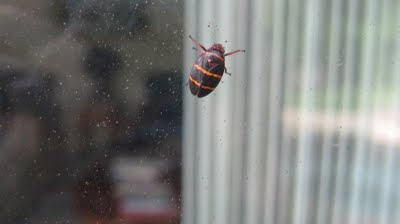
he was almost a full grown spittlebug
...and here is a two-lined spittlebug Alex & I saw at our house once. (Read more about spittlebugs here.)
TThere were also lots of mushrooms. A recent post I read at Weird, Unsocialized Homeschoolers explained that some mushrooms go through several stages... from convex (like this one)... to the plane stage (no photo)

...to depressed, like this one! I would like to watch a mushroom and take a series of photos some time. (These photos are actually different mushrooms.)

A mud dauber.

Paper wasps... I love how you can see inside the cells! I think I see eggs and possibly immature wasps!

And, one of the teens asked about this hole. The guide told us it was probably an armadillos den. Armadillos actually keep several dens. Leaves fall into the holes and insects bury themselves under the leaves. The armadillo then eats the insects when he visits this den before falling to sleep. That's one of the reasons they keep several homes! He also told us that a type of armadillo always has 4 identical babies... so they are either all females or all males! This makes them valuable to researchers. They are also one of very few animals that contract leprosy, so they are useful for studying that disease. Isn't it neat how God made creatures so amazing and helpful to us!!! (Armadillo Online! has TONS of info about these fascinating animals.)

Related Posts with Thumbnails