- The Greater Journey by David McCullough (mentioned here)
- Matilda by Roald Dahl
- Out of the Dust by Karen Hesse (review)
- An American Plague: The True and Terrifying Story of the Yellow Fever Epidemic of 1793 by Jim Murphy (review)
- Whale Song by Cheryl Kaye Tardif (review)
- The Education of a Wandering Man by Louis L'Amour (review)
- The Reading Promise by Alice Ozma (review)
- Harry Potter and the Sorcerer's Stone by J K Rowling
- Harry Potter and the Chamber of Secrets by J K Rowling
- Between Shades of Gray by Ruta Sepetys (review)
- War Horse by Michael Morpurgo (review)
- Harry Potter and the Prisoner of Azkaban by J K Rowling
- Waiting for Anya by Michael Morpurgo (review)
- The Impossible Journey by Gloria Whelan (review)
- Breaking Stalin's Nose by Eugene Velchin (review)
- The Wanigan: A Life on the River by Gloria Whelan (review)
- Hidden by Helen Frost (review)
- Miranda's Last Stand by Gloria Whelan (review)
- Listening for Lions by Gloria Whelan (review)
- Homeless Bird by Gloria Whelan
- Chu Ju's House by Gloria Whelan (review)
- Wulf the Saxon: A Story of the Norman Conquest by G A Henty (review)
- The Pioneer Woman: Black Heels to Tractor Wheels by Ree Drummond (review)
- Matched by Ally Condie (review)
- Crossed by Ally Condie (review)
- Alice's Adventures in Wonderland by Lewis Carroll (review)
- The Grimm Legacy by Polly Shulman (review)
- Five Conversations You Must Have with Your Daughter by Vicki Courtney
- The Last Lecture by Randy Pausch (review)
- The Autobiography of Mrs Tom Thumb: A Novel by Melanie Benjamin
- In the Reign of Terror by G. A. Henty (review)
- Madame Tussaud: A Novel of the French Revolution by Michelle Moran (review)
- Texas Angel by Judith Pella
- Heaven's Road by Judith Pella
- Harry Potter and the Goblet of Fire by J K Rowling
- Edge of Apocalypse (The End Series) by Tim LaHaye & Craig Parshall
- The Outsiders by S.E. Hinton
- The Green Coat: A Tale from the Dust Bowl Years by Rosemary McDunn
- The Summer of the Swans by Betsy Byars
- Dark Water Rising by Marian Hale
- The False Prince: Book 1 of the Ascendance Trilogy by Jennifer A. Nielsen
- Ender's Game by Orson Scott Card
- Harry Potter and the Order of the Phoenix by J K Rowling
- Turn Right at Machu Picchu by Mark Adams
- Harry Potter and the Half-Blood Prince by J K Rowling
- The Murder of the Century by Paul Collins
- Lone Wolf by Jodi Picoult (review)
- The Story of Charlotte's Web: E. B. White's Eccentric Life in Nature and the Birth of an American Classic by Michael Sims
- Moloka'i by Alan Brennert
- Silent Night by Mary Higgins Clark
- All Through the Night by Mary Higgins Clark
- Defending Jacob by William Landay
- The Swerve: How the World Became Modern by Stephen Greenblatt
- The Summons by John Grisham
- 11/22/63 by Stephen King (review)
- And Then There Were None by Agatha Christie (review)
- Oliver Twist by Charles Dickens (review)
- The Christmas Box by Richard Paul Evans (review)
- Finding Noel by Richard Paul Evans (review)
- Cleopatra's Daughter by Michelle Moran (review)
- Never Cry Wolf by Farley Mowat (review)
- Airframe by Michael Crichton (review)
- A Christmas Blizzard by Garrison Keillor (review)
Showing posts sorted by relevance for query an american plague. Sort by date Show all posts
Showing posts sorted by relevance for query an american plague. Sort by date Show all posts
Tuesday, January 01, 2013
A List of 63 Books Read in 2012
By far, I read the most books I've ever read in 2012. I started the year with a goal of reading 50 books... and ended up reading 63! I read a great variety of books from memoirs (like The Education of a Wandering Man by Louis L'Amour) to science fiction (like Ender's Game by Orson Scott Card). I discovered new authors (like Ruta Septys' Between Shades of Grey) and classics (like Dickens' Oliver Twist). I read books written for the young (like books by Gloria Whelan) and for adults (like David McCullough's The Greater Journey). It was an amazing journey as I read book after book, laughed and cried, and learned about different times and places... even imaginary ones! I had a wonderful year of reading. Here's a list of those books from the first to the last...

Wednesday, February 08, 2012
Historical Fiction and Nonfiction for Children
I am currently taking an online class called "Writing for Children". I'm not sure if I'll really do anything with it, but it is something that interests me. If I did ever try to write books for kids, I would probably do either historical fiction or nonfiction.
Since the best way to become a writer is to 'read, read, read!", we are sent to a library or bookstore for basically every lesson. The lesson I just completed was about historical fiction and nonfiction and I wrote a lengthy post about some of what I'd found during my trip to the library. I thought I'd share it in case it might get someone interested in one of the books I review or even gives them insight into the writing process. So, here's my post from class...

I spent a few hours at the library yesterday and had a wonderful time sampling historical fiction books for YA. My surprising favorite was Out of the Dust by Karen Hesse. Why surprising? Well, first of all, I didn't really care for the cover - just an old hoto of a girl in a hat. It looked kind of boring to me. And, secondly, I opened it and discovered it was all written in poetry! Not rhyming poetry, but definitely set up as poems. But, I started reading and was pleasantly surprised!
The topic of the book is the Oklahoma Dust Bowls. I grew up in Oklahoma, so this is a topic I am personally interested in! My husband's grandparents, in fact, lived on farms in Oklahoma during this time. (And, I'm going to have to ask them about it!)
So, the story is told from the point of view of a 13 year old girl named Billie Jo. She gets upset because some of the neighbors are having a contest to see who can kill the most rabbits because the rabbits are damaging their crops. But Billie Jo says that "grown men clubbing bunnies to death" makes her sick. But, she's glad they gave the rabbit meat to families that really needed it.
Later, she's asked to play the piano for an event, and she dreams of going to DC someday and playing for President Roosevelt. And, another section talks about meal time...how they set the table with the plates and glasses upside down and the napkin over the silverware and they don't turn them over until the last minute - to keep the dust away, of course! But, Daddy comments that the "potatoes are peppered plenty tonight" and likes his "chocolate milk" for dinner, when really they are both just the result of dust.
The book tells a lot about the dust bown and what life was like for a young girl at this time. And, it is probably a quick read with the short, poetic type chapters that read easily. I'm going to finish this one!
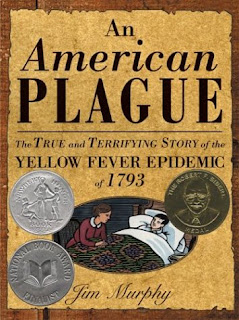
The YA nonfiction book I chose to read was An American Plague: The True & Terrifying Story of the Yellow Fever Epidemic of 1793. Wow! This is an incredible, true story by Jim Murphy and he did a LOT of research! The back of the book includes 13 pages of "sources", many of them with notes! The sources includ books, newspapers, magazines, personal journals, and letters. I liked that he accomplished his research without any interviews...a process that I'm a little intimidated by!
I think the story reads like fiction...just so smooth and you really get into the lives of the 'characters!' It is not stuffy or factual, though filled with researched facts. He includes quite a few quotes, often short ones like a description by a doctor saying the rash "resembled moscheto bites." It makes the story so much more 'real'! And, of course, it is a realy story!
Since nonfiction or historical fiction is what I'd probably like to write, I really loved this lesson. So, I'd love to talk about two more things....

First, I am listening to a lecture series about cathedrals and requested an ILL book at the library for David Macaulay's Cathedral book. I accidentally got a copy of "Building the Book Cathedral." Well, the book tells about how Macaulay wrote the book! His FIRST! It talks about going to a children's publisher with an idea and two drawings...and how they got excited about a totally different story than the one he'd presented. And, he went with it! The story of building a cathedral. Macaulay actually took half of his advance and headed to Paris to do some research. He shows his sketches, his drafts, his first submitted manuscript (which he said looked like a "war casualty" when he got it back.) I think this is a great book to see the process a first-timer went through in getting published!

Lastly, I went to the children's area and found four books that looked intersting by Kelly Milner Halls, one of the authors mentioned in this lesson. The books are "Mysteries of the Mummy Kids", "Albino Animals", "Dinosaur Mummies", and "Tales of the Cryptids."

The first one I opened was the book about dinosaur mummies. The first page is an introduction in which Halls talks about growing up in Friendswood, TX as a little amateur naturalist. She loved finding anoles and watching their tales grow back! Years later, when she was at her first natural history museum, she saw the dinosaur skeletons that reminded her of the lizards she loved as a child. When she grew up to become a writer, she said, she "got lots of chances to dig dinosaur bones with paleo-experts."
At the back of the book, she gives mini-bios of some paleontologists and a lengthy list of resources for kids (or adults!) to look at if they are interestd. Then, she also gives a bibliograhy with a list of books, articles & websites, and "personal interviews and correspondence" that she used to create the book! That's a lot of research!
P.S. I also visited David Macaulay's site and watched a talk he did on TED called "All Roads Lead to Rome Antics", which is the story of how he created his Rome Antics book (above). I thought this was a great video for an aspiring author to write as it gives a lot of insight to all of the ideas he considered and trashed.
I am also watching a video based on David Macaulay's Cathedral book (embeded above). This is a wonderful movie about cathedrals which goes back and forth between the storybook world of Macaulay's Cathedral and real cathedrals with narration by David Macaulay himself. In the cartoon world, there is a great visual of how the heavy arched roofs were made and another section showing how the stained glass windows were created. Although the video is a little grainy, it is a wonderful addition to anyone wanting to learn about cathedrals! And, I believe you can borrow the same video from your library and the quality might be a little better.
Since the best way to become a writer is to 'read, read, read!", we are sent to a library or bookstore for basically every lesson. The lesson I just completed was about historical fiction and nonfiction and I wrote a lengthy post about some of what I'd found during my trip to the library. I thought I'd share it in case it might get someone interested in one of the books I review or even gives them insight into the writing process. So, here's my post from class...
I spent a few hours at the library yesterday and had a wonderful time sampling historical fiction books for YA. My surprising favorite was Out of the Dust by Karen Hesse. Why surprising? Well, first of all, I didn't really care for the cover - just an old hoto of a girl in a hat. It looked kind of boring to me. And, secondly, I opened it and discovered it was all written in poetry! Not rhyming poetry, but definitely set up as poems. But, I started reading and was pleasantly surprised!
The topic of the book is the Oklahoma Dust Bowls. I grew up in Oklahoma, so this is a topic I am personally interested in! My husband's grandparents, in fact, lived on farms in Oklahoma during this time. (And, I'm going to have to ask them about it!)
So, the story is told from the point of view of a 13 year old girl named Billie Jo. She gets upset because some of the neighbors are having a contest to see who can kill the most rabbits because the rabbits are damaging their crops. But Billie Jo says that "grown men clubbing bunnies to death" makes her sick. But, she's glad they gave the rabbit meat to families that really needed it.
Later, she's asked to play the piano for an event, and she dreams of going to DC someday and playing for President Roosevelt. And, another section talks about meal time...how they set the table with the plates and glasses upside down and the napkin over the silverware and they don't turn them over until the last minute - to keep the dust away, of course! But, Daddy comments that the "potatoes are peppered plenty tonight" and likes his "chocolate milk" for dinner, when really they are both just the result of dust.
The book tells a lot about the dust bown and what life was like for a young girl at this time. And, it is probably a quick read with the short, poetic type chapters that read easily. I'm going to finish this one!

The YA nonfiction book I chose to read was An American Plague: The True & Terrifying Story of the Yellow Fever Epidemic of 1793. Wow! This is an incredible, true story by Jim Murphy and he did a LOT of research! The back of the book includes 13 pages of "sources", many of them with notes! The sources includ books, newspapers, magazines, personal journals, and letters. I liked that he accomplished his research without any interviews...a process that I'm a little intimidated by!
I think the story reads like fiction...just so smooth and you really get into the lives of the 'characters!' It is not stuffy or factual, though filled with researched facts. He includes quite a few quotes, often short ones like a description by a doctor saying the rash "resembled moscheto bites." It makes the story so much more 'real'! And, of course, it is a realy story!
Since nonfiction or historical fiction is what I'd probably like to write, I really loved this lesson. So, I'd love to talk about two more things....

First, I am listening to a lecture series about cathedrals and requested an ILL book at the library for David Macaulay's Cathedral book. I accidentally got a copy of "Building the Book Cathedral." Well, the book tells about how Macaulay wrote the book! His FIRST! It talks about going to a children's publisher with an idea and two drawings...and how they got excited about a totally different story than the one he'd presented. And, he went with it! The story of building a cathedral. Macaulay actually took half of his advance and headed to Paris to do some research. He shows his sketches, his drafts, his first submitted manuscript (which he said looked like a "war casualty" when he got it back.) I think this is a great book to see the process a first-timer went through in getting published!

Lastly, I went to the children's area and found four books that looked intersting by Kelly Milner Halls, one of the authors mentioned in this lesson. The books are "Mysteries of the Mummy Kids", "Albino Animals", "Dinosaur Mummies", and "Tales of the Cryptids."

The first one I opened was the book about dinosaur mummies. The first page is an introduction in which Halls talks about growing up in Friendswood, TX as a little amateur naturalist. She loved finding anoles and watching their tales grow back! Years later, when she was at her first natural history museum, she saw the dinosaur skeletons that reminded her of the lizards she loved as a child. When she grew up to become a writer, she said, she "got lots of chances to dig dinosaur bones with paleo-experts."
At the back of the book, she gives mini-bios of some paleontologists and a lengthy list of resources for kids (or adults!) to look at if they are interestd. Then, she also gives a bibliograhy with a list of books, articles & websites, and "personal interviews and correspondence" that she used to create the book! That's a lot of research!
P.S. I also visited David Macaulay's site and watched a talk he did on TED called "All Roads Lead to Rome Antics", which is the story of how he created his Rome Antics book (above). I thought this was a great video for an aspiring author to write as it gives a lot of insight to all of the ideas he considered and trashed.
I am also watching a video based on David Macaulay's Cathedral book (embeded above). This is a wonderful movie about cathedrals which goes back and forth between the storybook world of Macaulay's Cathedral and real cathedrals with narration by David Macaulay himself. In the cartoon world, there is a great visual of how the heavy arched roofs were made and another section showing how the stained glass windows were created. Although the video is a little grainy, it is a wonderful addition to anyone wanting to learn about cathedrals! And, I believe you can borrow the same video from your library and the quality might be a little better.
Subscribe to:
Posts (Atom)


