Saturday, January 12, 2013

Visiting D-Day Sites in Normandy: American Cemetery

Our 3rd stop on our half day tour with Eva was the American Cemetery. When you are on the cemetery grounds, you are standing on American soil!


To get to the cemetery from the parking lot, you walk down a wooded path.
 
 
Then you entered "The Garden of the Missing". On these walls are listed "the missing in action who gave their lives in this region." If I remember correctly, they were separated by branch of service.
 
 
In cases were remains were later recovered, identified and buried, a bronze rosette is placed beside the name. As you can see, besides the name of the missing, you'll also find their rank, unit, and state from which they served.
 
 
Then you enter the memorial. In the center is a statue. On either side is a map - this one is titled "Military Operations in Western Europe: 6 June 1944-8 May 1945."
 
 
Walking out of the memorial, you get your first glance at the headstones. Usually, there is a reflecting pond here, but it was drained at this time and a man was working in ti.
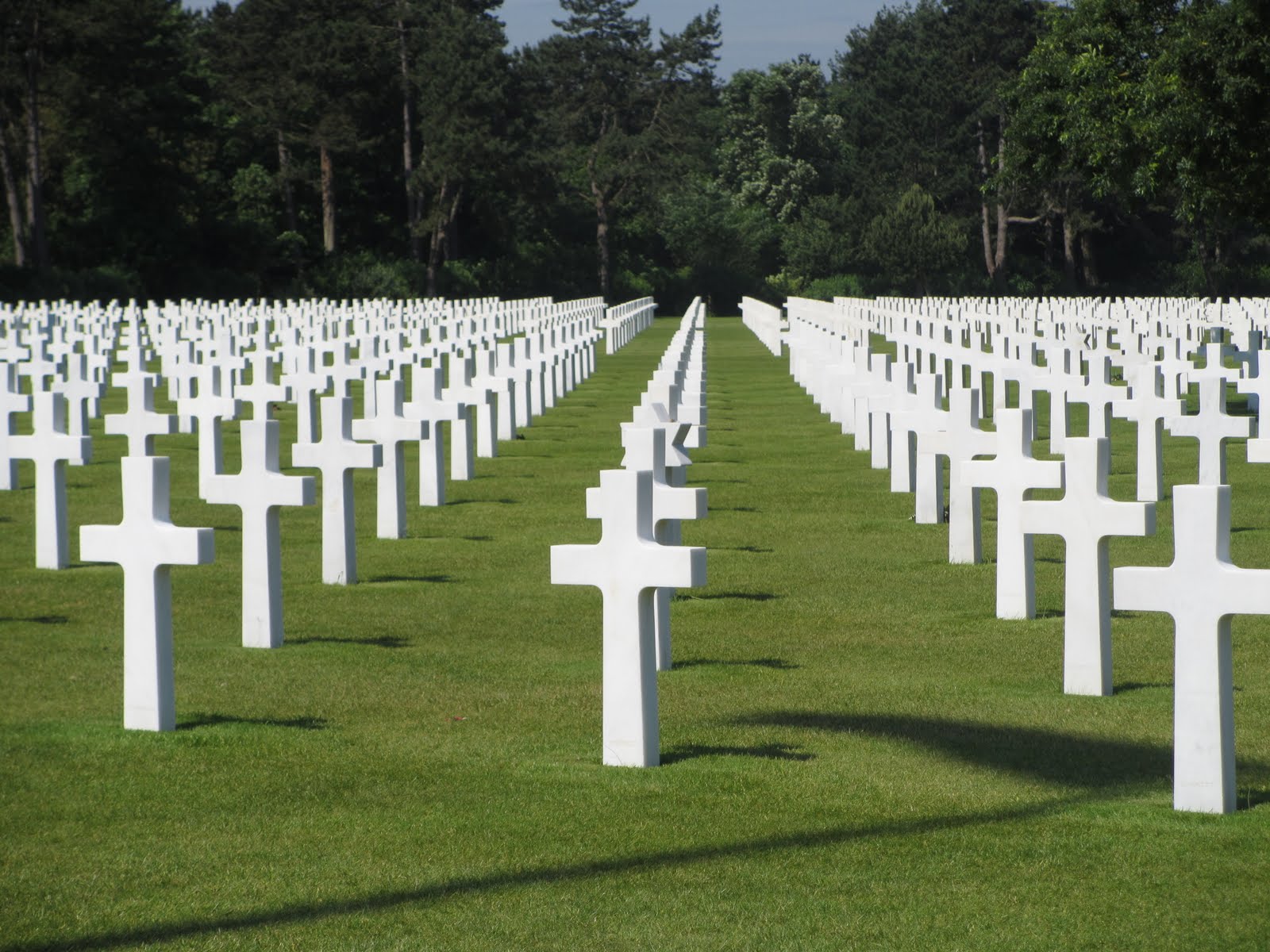
 
 
The cemetery is divided into 10 plots with a central path. The headstones are made of white marble with Latin crosses and Stars of David. Although the families of those Americans killed in this area were given the choice to have their remains moved home, many chose to have their bodies remain here... on the land they fought so hard to free.
 
 
This is a grave of an unknown soldier. It says "Here rests in honored glory a comrade in arms known but to God."
 
 
There are also women buried in the cemetery. Elizabeth A Richardson served with the American Red Cross and died June 25, 1945.
 
 
A Star of David headstone for a Jewish soldier. I first saw the stones placed on these graves at Arlington Cemetery in Washington, D.C.
 
 
In a second building, the chapel, there was this mosaic ceiling. According to the American Battle Monument Commission brochure, it depicts "America blessing her sons as they depart by sea and air" on the left and "a grateful France bestowing a laurel wreath upon the American dead" on the right.
 
 
From the edge of the cemetery, you can see how it overlooks Omaha Beach. Some of the soldiers who died on D-Day were originally buried at the beach but were later moved to this cemetery.
 
 
Lastly, I want to recomend 4 videos that are shown at the cemetery's visitor's center. The first is a two minute video about the cemetery itself titled "Normandy American Cemetery." The second is title "Letters" and you meet some of the soldiers who are buried here through letters, home photos & videos, and learning more about their lives before the war and when they died. This one really had me crying! The third is called "On Their Shoulders" and it tells the specific stories of 3 men who were killed - another very moving video. And, the fourth is "OK, Let's Go" about Eisenhower's decision to launch Operation Overlord on June 6th. Another touching film! You can find all four videos at the American Battle Monuments Commission site.

Visiting D-Day Sites in Normandy: Omaha Beach

After visiting Pointe du Hoc, Eva, tooks us on the short trip to Omaha Beach. I watched an incredible movie title Surviving D-Day and I'll use it for some of my facts. Again, Eva shared so much with us! But, I didn't write it down and have forgotten a lot of it.

 
The drive to the beach takes you past a little community of rental property. At the top of these cliffs which overlook the beach, you can see two openings (in top, bare area near center left) where Germans hid and shot their guns. As the Allies made landfall, many of them believed they would not survive. And, many didn't. Four hours before the landing, Allied planes dropped 13,000 bombs intending to knock out much of the German resistance. The Allies had bragged about their accuracy. But, there were low clouds and the planes were forced to use new radar equipment. To protect the Allied ships in the English Channel, orders were given to wait 5-30 seconds after getting to where the airmen though the target. The planes dropped their bombs too late, and not a single one of the 13,000 bombs hit the targets!

(outside of museum near Omaha beach which we unfortunately didn't have time to visit)
When the landing craft opened the doors to let the soldiers attack the beach, many were shot immediately. The open doors were a target for the incredible MG42's of the Germans. These machine guns could shoot 25 bullet per second! Many who survived did not go through the opened gate, but jumped over the sides of their landing craft. Many of these drowned in their heavy gear. And, many were seasick because of the huge breakfast they'd eaten. When they reached the beaches, there were obstacles like these hedgehogs in my photo above. These had been placed on the beach to prevent a high-tide landing by the Allies.


Besides the machine guns, the Germans also fired with these artillery. This one overlooks the beach and is behind a heavy fence. The beach, when the Allies landed, wa 1000 feet long - or 3 football fields long. Besides the machinegun fire, artillery fire, and obstacles like the hedgehogs (which could also be used to hide behind somewhat), there were over 17,000 mines!
 
 
We visited at high tide and didn't actually step foot on the beach, which I regret now. The tide was going out and we aw a few people on the beach later. As the Allies fought to take the beach, the tide came in squishing the surviving soldiers together.


After capturing the beach and losing over 2,000 soldiers, the Allies would build a man-made harbor called a Mulberry Harbour. But, about 10 days later, a storm came up and destroyed this harbor. This is part of the remains of that structure.


As we left Omaha beach, we drove past this monument which says: The Allied forces landing on this shore which they call Omaha beach liberate Europe June 6th 1944. Surrounding the monument are 8 flags. It was noon, and they were having a flag raising ceremony! The flags were raised one by one while the national anthem of that country was played.


The raising of the United States flag was a very moving experience. I'm glad my mom 'insisted' that we stopped as we were ready to drive on by! I was, and am, proud to be an American! Thank you to those who serve in the military to defend us and defend freedom!

Friday, January 11, 2013

Visiting D-Day Sites in Normandy: Pointe du Hoc

June 6th, 1944. The Germans occupied France and much of Europe. The Allies began their D-Day invasion to recapture the continent.

We booked a private half-day tour of the American sector sites of the D-Day invasion in Normandy. Our guide, Eva Ruttger with Experience Normandy, was FANTASTIC and obviously loved what she did. She told us the amazing story of the invasion and even had photos and maps to share with us. I wish I'd taken notes as I've forgotten a lot of what I learned! But, what I took away was the incredible planning that went into planning the invasion.


Alex, my mom, me, my brother & his girlfriend in front of a pillbox that would have housed a 'big gun'
This is a picture of us outside of one of the bunkers at Pointe du Hoc. The bunkers are where the Germans kept their 'big guns' which could shoot 10-12 miles and hit the ships at sea. Eisenhower wanted to make sure these guns were destroyed. Pointe du Hoc supposedly had five of these guns at this Pointe which overlooks Omaha Beach. Troops were supposed to land at 6:30 a.m. at Omaha Beach and the guns were supposed to be inoperable by then.


Alex, me & my brother standing in a crater at Pointe du Hoc- you can see a 'pillbox' in the background
American planes sent planes to drop bombs in the area of Omaha Beach. This was to clear a way for Allies when they landed. Because of bad weather, the targets were missed and Omaha Beach did not have any bomb craters where the soldiers could have hidden as they landed. But, here on Pointe du Hoc, there were craters.


After crossing the English Channel from England, the Rangers had to scale these 100 foot tall cliffs of Pointe du Hoc. While landing on the narrow shore and climbing the cliffs, they were being shot at and having gernades thrown down on them. There's a great, 9 minute clip from The Longest Day which shows this scaling and shows the very places I've photographed and visited.

Part of a monument at the site
Here is a quote by President Reagan on the 40th anniversay of D-Day: June 6, 1984:
The Rangers looked up and saw the enemy soldiers - the edge of the cliffs shooting down at them with machineguns and throwing gernades. And the American Rangers began to climb. They shot rope ladders over the face of these cliffs and began to pull themselves up. When one ranger fell, another would take his place. When one rope was cut, a ranger would grab another and begin his climb again. They climbed, shot back, and held their footing. Soon, one by one, the rangers pulled themselves over the top, and in seizing the firm land at the top of these cliffs, they began to seize back the continent of Europe. Two hundred and twenty-five came here. After 2 days of fighting, only 90 could still bear arms.

This is a relief map from that monument. The water (closest to us) is the English Channel. The The part that sticks out is where Pointe du Hoc is located. On the left side of the photo is another American invasion site: Omaha Beach. On the right is a British invasion point: Utah Beach.


Here's a photo I took from near the tip of Pointe du Hoc. If you could see down below, you'd be able to see Omaha Beach.


Our wonderful guide is on the left - I'll have to look up her name and the name of her company. She was incredible! Anyway, this is also taken at the tip of Pointe du Hoc but looking away from Omaha Beach.


I'm standing inside of a bunker at the very edge of Pointe du Hoc. From this point the Germans could watch over the seas. The opening was maybe 2 foot tall and arched almost 180 degrees. There were also a couple of rooms in this structure where the troops must have lived or spent a lot of time. There were bullet holes in the walls from when the Allies captured this Pointe.

From here, we traveled to Omaha Beach... which will be a separate post.

Note: I got some of my information from the American Veterans site on a page titled "The Guns of Pointe du Hoc."

Visiting "Monet's Cathedral" in (aka Rouen Cathedral)

Jumping back to our Europe trip this summer.... here are photos of the Rouen Cathedral which was made famous by Monet. While I was there, I actually didn't realize we'd found Monet's cathedral! So, I don't even have a nice photo from the outside matching Monet's famous paintings! Oops!


File:Claude Monet 033.jpg
Monet, 1893 - image from Wikipeda
painting in Musee d'Orsay (which we saw on this trip!)
 
I wasn't sure what this image could represent and first wrote this post just describing it. I found it on a tympanum - the area over a cathedral entrance. But, then I realized there is a HEAD in the bowl that the servant is giving the queen (who is dressed richly and wearing a crown)! And, I knew what Biblical story it was portraying: the beheading of John the Baptist. Here it is from Matthew 14:6-11:
But on Herod's birthday, the daughter of Herodias danced before them: and pleased Herod. Whereupon he promised with an oath, to give her whatsoever she would ask of him. But she being instructed before by her mother, said: Give me here in a dish the head of John the Baptist. And the king was struck sad: yet because of his oath, and for them that sat with him at table, he commanded it to be given. And he sent, and beheaded John in the prison.
 
 
This scene is of Jesse's tree, a familiar site in art. It depicts the ancestors of Jesus and is from Isaiah 11:1: There shall come forth a shoot from the stump of Jesse, and a branch shall grow out of his roots.
 
 
I am standing in front of the nave - the main long portion of the cathedral where worshipers sit (though I think they used to stand). The vaulted ceiling is high above me and it's incredible to stand in these amazing structures.
 
 
Most cathedrals are built with a floorplan like a cross (or letter "t"). The long part is the nave, while the shorter part is the transept. This is the vaulted ceiling where the two parts cross.
 
 
Looking away from the apse (where the preaching would take place) towards the door I entered in through. You can see the pipes from the pipe organ and the rose window. You can also see the 3 layers of arches as you start from the floor and go upwards: arcade (lowest), triforium (middle), and clerstory (highest).

Saturday, January 05, 2013

Reading Challenge: Back to the Classics

I decided to join one more challenge for 2013... Back to the Classics! This challenge is hosted by Sarah Reads Too Much. What a great name!

 
The challenge consists of 6 required categories along with 5 optional categories. You can even win prizes at the end of the year! Here are the categories:
 
  1. A 19th Century Classic
  2. A 20th Century Classic
  3. A Pre-18th or 18th Century Classic
  4. A Classic that relates to the African-American Experience - This can be an African-American author, or a book relating to slavery, civil rights, or African-American culture.
  5. A Classic Adventure
  6. A Classic that prominently features an Animal - This can feature animal characters or animals in the title (real or imagined)
Optional Categories:
A. Re-read a Classic
B. A Russian Classic
C. A Classic Non-Fiction title
D. A Classic Children's/Young Adult title
E. Classic Short Stories

"Gilmore Girls" Reading List...

I used to watch Gilmore Girls and loved following bookish, scholastic Rory. I saw alist on M and J in a Nutshell which she'd seen on another blog. It is a list of books mentioned on the show. She had marked those she'd read and those she'd tried but abandoned. Sounds like fun to me! I'll be writing the books I've read in bold and the ones I've abandoned with an (A). So, here goes...


1984 by George Orwell
The Adventures of Huckleberry Finn by Mark Twain
Alice in Wonderland by Lewis Carroll
The Amazing Adventures of Kavalier & Clay by Michael Chabon
An American Tragedy by Theodore Dreiser
Angela’s Ashes by Frank McCourt
Anna Karenina by Leo Tolstoy
Anne Frank: The Diary of a Young Girl by Anne Frank

Archidamian War by Donald Kagan
The Art of Fiction by Henry James
The Art of War by Sun Tzu
As I Lay Dying by William Faulkner
Atonement by Ian McEwan
Autobiography of a Face by Lucy Grealy

The Awakening by Kate Chopin
Babe by Dick King-Smith
Backlash: The Undeclared War Against American Women by Susan Faludi
Balzac and the Little Chinese Seamstress by Dai Sijie
Bel Canto by Ann Patchett
The Bell Jar by Sylvia Plath
Beloved by Toni Morrison

Beowulf: A New Verse Translation by Seamus Heaney
The Bhagavad Gita
The Bielski Brothers: The True Story of Three Men Who Defied the Nazis, Built a Village in the Forest, and Saved 1,200 Jews by Peter Duffy
Bitch in Praise of Difficult Women by Elizabeth Wurtzel
A Bolt from the Blue and Other Essays by Mary McCarthy
Brave New World by Aldous Huxley
Brick Lane by Monica Ali
Bridgadoon by Alan Jay Lerner
Candide by Voltaire
The Canterbury Tales by Chaucer Carrie by Stephen King
Catch-22 by Joseph Heller
The Catcher in the Rye by J. D. Salinger
Charlotte’s Web by E. B. White

The Children’s Hour by Lillian Hellman
Christine by Stephen King
 A Christmas Carol by Charles Dickens
A Clockwork Orange by Anthony Burgess
The Code of the Woosters by P.G. Wodehouse
The Collected Short Stories by Eudora Welty
The Collected Stories of Eudora Welty by Eudora Welty
A Comedy of Errors by William Shakespeare
Complete Novels by Dawn Powell
The Complete Poems by Anne Sexton
Complete Stories by Dorothy Parker
A Confederacy of Dunces by John Kennedy Toole
The Count of Monte Cristo by Alexandre Dumas père
Cousin Bette by Honor’e de Balzac
Crime and Punishment by Fyodor Dostoevsky
The Crimson Petal and the White by Michel Faber
The Crucible by Arthur Miller
Cujo by Stephen King
The Curious Incident of the Dog in the Night-Time by Mark Haddon
Daisy Miller by Henry James
Daughter of Fortune by Isabel Allende
David and Lisa by Dr Theodore Issac Rubin M.D
David Copperfield by Charles Dickens
The Da Vinci -Code by Dan Brown
Dead Souls by Nikolai Gogol
Demons by Fyodor Dostoyevsky
Death of a Salesman by Arthur Miller
Deenie by Judy Blume

The Devil in the White City: Murder, Magic, and Madness at the Fair that Changed America by Erik Larson
The Dirt: Confessions of the World’s Most Notorious Rock Band by Tommy Lee, Vince Neil, Mick Mars and Nikki Sixx
The Divine Comedy by Dante
The Divine Secrets of the Ya-Ya Sisterhood by Rebecca Wells
Don Quixote by Cervantes
Driving Miss Daisy by Alfred Uhrv
Dr. Jekyll & Mr. Hyde by Robert Louis Stevenson
Edgar Allan Poe: Complete Tales & Poems by Edgar Allan Poe
Eleanor Roosevelt by Blanche Wiesen Cook
The Electric Kool-Aid Acid Test by Tom Wolfe
Ella Minnow Pea: A Novel in Letters by Mark Dunn
Eloise by Kay Thompson
Emily the Strange by Roger Reger
Emma by Jane Austen
Empire Falls by Richard Russo
Encyclopedia Brown: Boy Detective by Donald J. Sobol
Ethan Frome by Edith Wharton

Ethics by Spinoza
Europe through the Back Door, 2003 by Rick Steves
Eva Luna by Isabel Allende
Everything Is Illuminated by Jonathan Safran Foer
Extravagance by Gary Krist
Fahrenheit 451 by Ray Bradbury
Fahrenheit 9/11 by Michael Moore
The Fall of the Athenian Empire by Donald Kagan
Fat Land: How Americans Became the Fattest People in the World by Greg Critser
Fear and Loathing in Las Vegas by Hunter S. Thompson
The Fellowship of the Ring: Book 1 of The Lord of the Ring by J. R. R. Tolkien
Fiddler on the Roof by Joseph Stein
The Five People You Meet in Heaven by Mitch Albom
Finnegan’s Wake by James Joyce
Fletch by Gregory McDonald
Flowers for Algernon by Daniel Keyes
The Fortress of Solitude by Jonathan Lethem
The Fountainhead by Ayn Rand
Frankenstein by Mary Shelley
Franny and Zooey by J. D. Salinger
Freaky Friday by Mary Rodgers
Galapagos by Kurt Vonnegut
Gender Trouble by Judith Butler
George W. Bushism: The Slate Book of the Accidental Wit and Wisdom of our 43rd President by Jacob Weisberg
Gidget by Fredrick Kohner
Girl, Interrupted by Susanna Kaysen
The Gnostic Gospels by Elaine Pagels
The Godfather: Book 1 by Mario Puzo
The God of Small Things by Arundhati Roy
Goldilocks and the Three Bears by Alvin Granowsky
Gone with the Wind by Margaret Mitchell
The Good Soldier by Ford Maddox Ford
The Gospel According to Judy Bloom
The Graduate by Charles Webb
The Grapes of Wrath by John Steinbeck
The Great Gatsby by F. Scott Fitzgerald
Great Expectations by Charles Dickens
The Group by Mary McCarthy
Hamlet by William Shakespeare
Harry Potter and the Goblet of Fire by J. K. Rowling
Harry Potter and the Sorcerer’s Stone by J. K. Rowling

A Heartbreaking Work of Staggering Genius by Dave Eggers
Heart of Darkness by Joseph Conrad
Helter Skelter: The True Story of the Manson Murders by Vincent Bugliosi and Curt Gentry
Henry IV, part I by William Shakespeare
Henry IV, part II by William Shakespeare
Henry V by William Shakespeare
High Fidelity by Nick Hornby
The History of the Decline and Fall of the Roman Empire by Edward Gibbon
Holidays on Ice: Stories by David Sedaris
The Holy Barbarians by Lawrence Lipton
House of Sand and Fog by Andre Dubus III
The House of the Spirits by Isabel Allende
How to Breathe Underwater by Julie Orringer
How the Grinch Stole Christmas by Dr. Seuss
How the Light Gets in by M. J. Hyland
Howl by Allen Gingsburg
The Hunchback of Notre Dame by Victor Hugo
The Iliad by Homer
I’m with the Band by Pamela des Barres

In Cold Blood by Truman Capote
Inherit the Wind by Jerome Lawrence and Robert E. Lee
Iron Weed by William J. Kennedy
It Takes a Village by Hillary Clinton
Jane Eyre by Charlotte Brontë
The Joy Luck Club by Amy Tan

Julius Caesar by William Shakespeare
The Jumping Frog by Mark Twain
The Jungle by Upton Sinclair
Just a Couple of Days by Tony Vigorito
The Kitchen Boy: A Novel of the Last Tsar by Robert Alexander
The Kite Runner by Khaled Hosseini
Lady Chatterleys’ Lover by D. H. Lawrence
The Last Empire: Essays 1992-2000 by Gore Vidal
Leaves of Grass by Walt Whitman
The Legend of Bagger Vance by Steven Pressfield
Less Than Zero by Bret Easton Ellis
Letters to a Young Poet by Rainer Maria Rilke

Lies and the Lying Liars Who Tell Them by Al Franken
Life of Pi by Yann Martel
The Lion, The Witch and The Wardrobe by C.S. Lewis

Little Dorrit by Charles Dickens
The Little Locksmith by Katharine Butler Hathaway
The Little Match Girl by Hans Christian Andersen
*Little Women by Louisa May Alcott
Living History by Hillary Rodham Clinton
Lord of the Flies by William Golding
The Lottery: And Other Stories by Shirley Jackson
The Lovely Bones by Alice Sebold
The Love Story by Erich Segal
Macbeth by William Shakespeare
Madame Bovary by Gustave Flaubert
The Manticore by Robertson Davies
Marathon Man by William Goldman
The Master and Margarita by Mikhail Bulgakov
Memoirs of a Dutiful Daughter by Simone de Beauvoir
Memoirs of General W. T. Sherman by William Tecumseh Sherman
Me Talk Pretty One Day by David Sedaris
The Meaning of Consuelo by Judith Ortiz Cofer
Mencken’s Chrestomathy by H. R. Mencken
The Merry Wives of Windsro by William Shakespeare
The Metamorphosis by Franz Kafka
Middlesex by Jeffrey Eugenides
The Miracle Worker by William Gibson
Moby Dick by Herman Melville
The Mojo Collection: The Ultimate Music Companion by Jim Irvin
Moliere: A Biography by Hobart Chatfield Taylor
A Monetary History of the United States by Milton Friedman
Monsieur Proust by Celeste Albaret
A Month Of Sundays: Searching For The Spirit And My Sister by Julie Mars
A Moveable Feast by Ernest Hemingway
Mrs. Dalloway by Virginia Woolf
Mutiny on the Bounty by Charles Nordhoff and James Norman Hall
My Lai 4: A Report on the Massacre and It’s Aftermath by Seymour M. Hersh
My Life as Author and Editor by H. R. Mencken
My Life in Orange: Growing Up with the Guru by Tim Guest
My Sister’s Keeper by Jodi Picoult
The Naked and the Dead by Norman Mailer
The Name of the Rose by Umberto Eco
The Namesake by Jhumpa Lahiri
The Nanny Diaries by Emma McLaughlin
Nervous System: Or, Losing My Mind in Literature by Jan Lars Jensen
New Poems of Emily Dickinson by Emily Dickinson
The New Way Things Work by David Macaulay
Nickel and Dimed by Barbara Ehrenreich
Night by Elie Wiesel

Northanger Abbey by Jane Austen
The Norton Anthology of Theory and Criticism by William E. Cain, Laurie A. Finke, Barbara E. Johnson, John P. McGowan
Novels 1930-1942: Dance Night/Come Back to Sorrento, Turn, Magic Wheel/Angels on Toast/A Time to be Born by Dawn Powell
Notes of a Dirty Old Man by Charles Bukowski
Of Mice and Men by John Steinbeck

Old School by Tobias Wolff
Oliver Twist by Charles Dickens
On the Road by Jack Kerouac
(A) One Day in the Life of Ivan Denisovitch by Alexander Solzhenitsyn
One Flew Over the Cuckoo’s Nest by Ken Kesey
One Hundred Years of Solitude by Gabriel Garcia Marquez
The Opposite of Fate: Memories of a Writing Life by Amy Tan
Oracle Night by Paul Auster
Oryx and Crake by Margaret Atwood
Othello by Shakespeare
Our Mutual Friend by Charles Dickens
The Outbreak of the Peloponnesian War by Donald Kagan
Out of Africa by Isac Dineson
The Outsiders by S. E. Hinton
A Passage to India by E.M. Forster
The Peace of Nicias and the Sicilian Expedition by Donald Kagan
The Perks of Being a Wallflower by Stephen Chbosky
Peyton Place by Grace Metalious
The Picture of Dorian Gray by Oscar Wilde
Pigs at the Trough by Arianna Huffington
Pinocchio by Carlo Collodi
Please Kill Me: The Uncensored Oral History of Punk Legs McNeil and Gillian McCain
The Polysyllabic Spree by Nick Hornby
The Portable Dorothy Parker by Dorothy Parker
The Portable Nietzche by Fredrich Nietzche
The Price of Loyalty: George W. Bush, the White House, and the Education of Paul O’Neill by Ron Suskind
Pride and Prejudice by Jane Austen
Property by Valerie Martin
Pushkin: A Biography by T. J. Binyon
Pygmalion by George Bernard Shaw
Quattrocento by James Mckean
A Quiet Storm by Rachel Howzell Hall
Rapunzel by Grimm Brothers
The Raven by Edgar Allan Poe
The Razor’s Edge by W. Somerset Maugham
Reading Lolita in Tehran: A Memoir in Books by Azar Nafisi
Rebecca by Daphne du Maurier
Rebecca of Sunnybrook Farm by Kate Douglas Wiggin
The Red Tent by Anita Diamant
Rescuing Patty Hearst: Memories From a Decade Gone Mad by Virginia Holman
The Return of the King: The Lord of the Rings Book 3 by J. R. R. Tolkien
R Is for Ricochet by Sue Grafton
Rita Hayworth by Stephen King
Robert’s Rules of Order by Henry Robert
Roman Fever by Edith Wharton
Romeo and Juliet by William Shakespeare
A Room of One’s Own by Virginia Woolf
A Room with a View by E. M. Forster
Rosemary’s Baby by Ira Levin
Sacred Time by Ursula Hegi
Sanctuary by William Faulkner
Savage Beauty: The Life of Edna St. Vincent Millay by Nancy Milford
The Scarecrow of Oz by Frank L. Baum
The Scarlet Letter by Nathaniel Hawthorne
Seabiscuit: An American Legend by Laura Hillenbrand
The Second Sex by Simone de Beauvoir
The Secret Life of Bees by Sue Monk Kidd
Secrets of the Flesh: A Life of Colette by Judith Thurman
Selected Letters of Dawn Powell: 1913-1965 by Dawn Powell
Sense and Sensibility by Jane Austen
A Separate Peace by John Knowles
Several Biographies of Winston Churchill
Sexus by Henry Miller
The Shadow of the Wind by Carlos Ruiz Zafon
Shane by Jack Shaefer
The Shining by Stephen King
Siddhartha by Hermann Hesse
S Is for Silence by Sue Grafton
Slaughter-house Five by Kurt Vonnegut
Small Island by Andrea Levy
Snows of Kilimanjaro by Ernest Hemingway
Snow White and Rose Red by Grimm Brothers
Social Origins of Dictatorship and Democracy: Lord and Peasant in the Making of the Modern World by Barrington Moore
The Song of Names by Norman Lebrecht
Song of the Simple Truth: The Complete Poems of Julia de Burgos by Julia de Burgos
The Song Reader by Lisa Tucker
Songbook by Nick Hornby
The Sonnets by William Shakespeare
Sonnets from the Portuegese by Elizabeth Barrett Browning
Sophie’s Choice by William Styron
The Sound and the Fury by William Faulkner
Speak, Memory by Vladimir Nabokov
Stiff: The Curious Lives of Human Cadavers by Mary Roach
The Story of My Life by Helen Keller
A Streetcar Named Desiree by Tennessee Williams
Stuart Little by E. B. White
Sun Also Rises by Ernest Hemingway
Swann’s Way by Marcel Proust
Swimming with Giants: My Encounters with Whales, Dolphins and Seals by Anne Collett
Sybil by Flora Rheta Schreiber
A Tale of Two Cities by Charles Dickens
Tender Is The Night by F. Scott Fitzgerald
Terms of Endearment by Larry McMurtry
Time and Again by Jack Finney
The Time Traveler’s Wife by Audrey Niffenegger
To Have and Have Not by Ernest Hemingway
To Kill a Mockingbird by Harper Lee
The Tragedy of Richard III by William Shakespeare
A Tree Grows in Brooklyn by Betty Smith
The Trial by Franz Kafka
The True and Outstanding Adventures of the Hunt Sisters by Elisabeth Robinson
Truth & Beauty: A Friendship by Ann Patchett
Tuesdays with Morrie by Mitch Albom
Ulysses by James Joyce
The Unabridged Journals of Sylvia Plath 1950-1962 by Sylvia Plath
Uncle Tom’s Cabin by Harriet Beecher Stowe
Unless by Carol Shields
Valley of the Dolls by Jacqueline Susann
The Vanishing Newspaper by Philip Meyers
Vanity Fair by William Makepeace Thackeray
Velvet Underground’s The Velvet Underground and Nico (Thirty Three and a Third series) by Joe Harvard
The Virgin Suicides by Jeffrey Eugenides
Waiting for Godot by Samuel Beckett
Walden by Henry David Thoreau
Walt Disney’s Bambi by Felix Salten
War and Peace by Leo Tolstoy
We Owe You Nothing – Punk Planet: The Collected Interviews edited by Daniel Sinker
What Colour is Your Parachute? 2005 by Richard Nelson Bolles
What Happened to Baby Jane by Henry Farrell
When the Emperor Was Divine by Julie Otsuka
Who Moved My Cheese? Spencer Johnson
Who’s Afraid of Virginia Woolf by Edward Albee
Wicked: The Life and Times of the Wicked Witch of the West by Gregory Maguire
The Wizard of Oz by Frank L. Baum
Wuthering Heights by Emily Brontë
The Yearling by Marjorie Kinnan Rawlings
The Year of Magical Thinking by Joan Didion
 

Book Review: Tatiana and Alexander by Paullina Simons

Tatiana and Alexander is the second book in the trilogy that started with The Bronze Horseman. I finished the first book a few days ago and immediately downloaded the second book to read. I had to know what happened next! (As I mentioned in my review of The Bronze Horseman, this book also has a lot of sexual content. However, this time a lot of it is in the italicized sections and I ended up just skipping page after page of this and the book still totally made sense. )

 
When this book starts, Tatiana has escaped to the United States and is about to have Alexander's baby. She left Alexander behind, believing him to be dead. As she tries to make a new life for herself, she is haunted by the thought that maybe her husband isn't dead after all.
 
 
Alexander, meanwhile, is still alive and fighting for his life. At times he acts as a ranked soldier again, while at other times he is imprisoned. He holds on to the belief that Tatiana is alive and well and tries to survive Stalin's "death machine" and find Tatiana.
 
The Registration Room on Ellis Island. Tatiana lived & worked on the island. My photo from our 2008 trip.
A lot of the story of Tatiana as she lives in NYC and is about her waiting and trying to decide if Alexander was really alive or not and whether or not she should go on with her life. This actually got a bit boring. And, as she was in the United States she was learning English and we had to read her conversations in broken English. I think this was confusing because it didn't 'sound' like the voice of Tatiana that I was accustomed to.
 
File:Sachsenhausen2.jpg
Sachsenhausen NKVD Special Camp (controlled by Gulag) in Germany where Alexander was held
photo from Wikipedia
Alexander's story, however, was more exciting. Not only was there more of the war and the 'history' (which is what I love about historical fiction!), you also learned more about his life as a child. Some of this was really interesting (including his life in the Gulag which I'd studied and read about last year), and other parts were disturbing. I came away not liking Alexander near as much after reading this book.
 
So, I'm happy to finish this trilogy after the first two books, but won't be reading the third. I gave this book 3 out of 5 stars.


Book Review: The Bronze Horseman by Paullina Simmons

I read The Bronze Horseman because I love reading about Russian history. It was quite a lon book at over 800 pages! But, I really enjoyed it... though I also had some issues with it. Well, one particular issue. The book contains a lot of sexual content. I've never read a Harlequin Romance book, but I can't imagine they could be much worse (both in amount and detail). It was ridiculous. However, the story and the history were wonderful.
 
The book starts in Leningrad  in 1941 on the day when the government announced that Hitler had broken the Nazi-Soviet Non-Aggression Pact and invaded Russia. Tatiana, a young girl just shy of 17, is sent to buy up all the food she can while her family sends her twin brother off to a boy's camp where they hope he'll be safe. Tatiana doesn't sense the urgency and by the time she starts looking for food she can't find what the family needs. But, she is helped by a handsome stranger -  a lieutenant in the Red Army.
 
File:RIAN archive 216 The Volkovo cemetery.jpg
3 men burying victims of Leningrad seige from wikipedia
The story continues to unfold as Leningrad becomes under siege: the infamous Siege of Leningrad which goes on for 900 days as the Russians bomb and attempt to starve the residents of the city. From Wikipedia: Civilians in the city suffered from extreme starvation, especially in the winter of 1941–1942. For example, from November 1941 to February 1942 the only food available to the citizen was 125 grams of bread, of which 50–60% consisted of sawdust and other inedible admixtures, and distributed through ration cards. For about two weeks at the beginning of January 1942, even this food was available only for workers and military personnel. In conditions of extreme temperatures (down to −30 °C (−22 °F)) and city transport being out of service, even a distance of a few kilometers to a food distributing kiosk created an insurmountable obstacle for many citizens. In January–February 1942, about 700–1,000 citizens died every day, most of them from hunger. People often died on the streets, and citizens soon became accustomed to the sight of death. This time period is graphically portrayed in this book.
 
My photo of Stalin statue in Estonia, 2012

While we follow Tatiana going through the seige of Leningrad, we follow Alexander as he rises through the ranks of the Russian army. Stalin was an incredibly harsh leader who let so many of his people die - both as soldiers and citizens. I talked more about Stalin at this post.
 
I gave the book 4 out of 5 stars. I would have given it 5 if it weren't for the sexual content. You can always flip through these pages and enjoy a wonderful historical story!

Friday, January 04, 2013

Book Review: Finding Noel by Richard Paul Evans

As I got near the end of Finding Noel, I was practically sobbing. What a heart-felt, touching story.
 
Here's what the back cover says about this book:

"The Christmas Season is supposed to be full of joy, but not for Mark Smart. Life had dealt him one body blow after another: he lost his scholarship and had to drop out of school; his beloved mother had died in a car crash; his girlfriend dumped him; and now, late on a snowy night in November, his car had broken down. Stumbling into a coffee house, he was looking for a phone to call a tow truck. What he found was a beautiful young woman with an unusual name who, through a simple act of kindness, changed his life forever.

Macy Wood had little memory of her birth parents and memories she'd rather forget of her adopted home. A Christmas ornament inscribed with the word "Noel" was the single clue to the little sister she only vaguely remembered, a clue that would send her and Mark on a journey to reclaim her past and her family."
 
This is a wonderful Christmas story I highly recommend!

Book Review: The Christmas Box by Richard Paul Evans


The Christmas Box was the first of two Christmas books I read by Richard Paul Evans last month. This was a very quick read with large print and blank pages between the chapters. It probably took me about an hour to read it. And, It was a very touching Christmas story, though I thought the reading was a little choppy.
 
 
The Christmas Box is a story about a young family who move in with a widow lady and do some chores in exchange for rent. But, what is the mystery of the Christmas box? And what secret is the widow keeping? And, what is the first Christmas gift?
Related Posts with Thumbnails